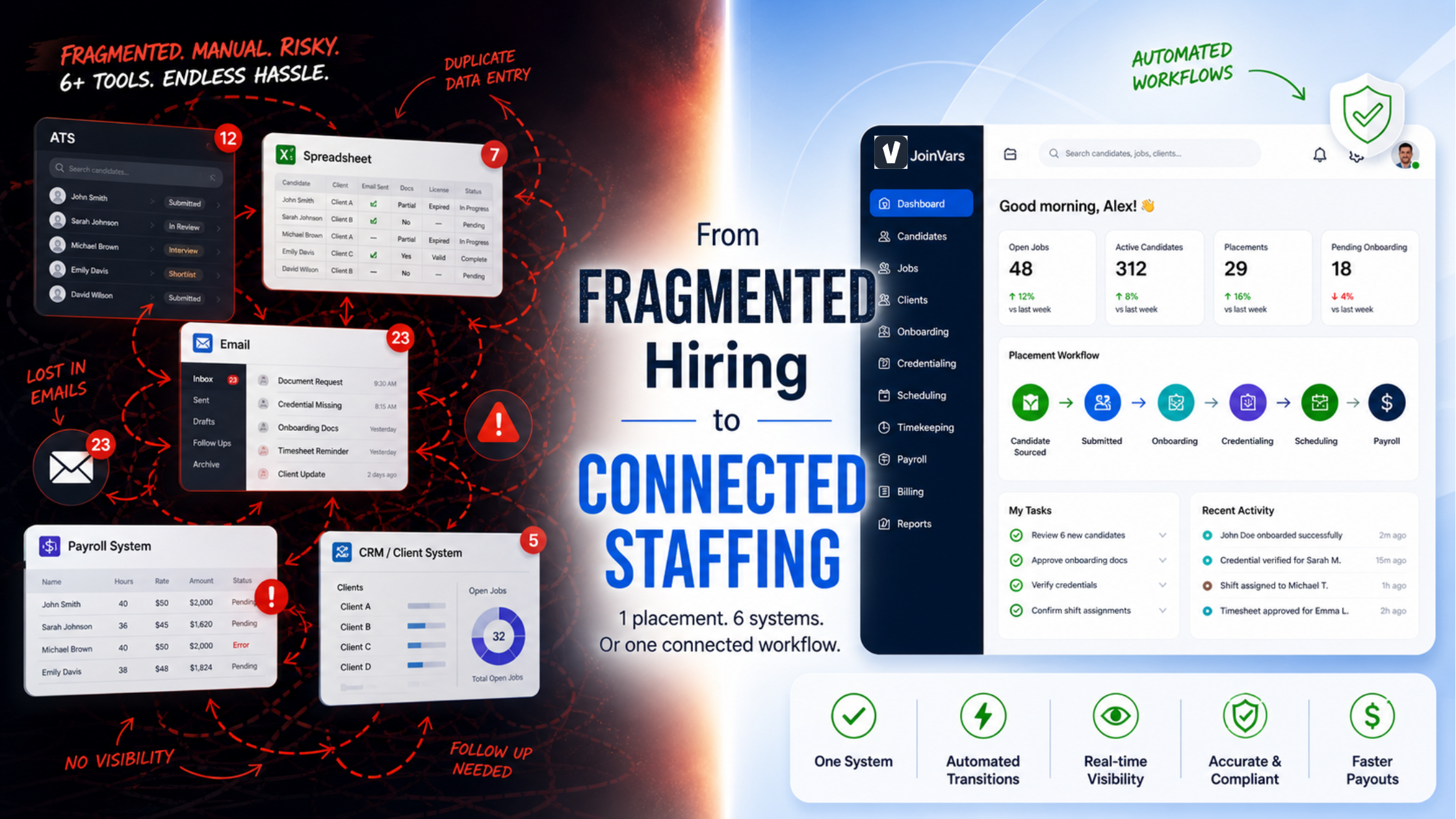
If you run a staffing agency in the US and you’re still evaluating ATS platforms in 2026, you’re probably asking the right question, but maybe not the complete one. The best ATS for staffing agencies isn’t just about tracking candidates. It’s about whether the platform can keep up with how your agency actually operates: multi-client job orders, recruiter handoffs, compliance tracking, onboarding, and billing, all moving at the same time.
This guide breaks down what to look for, what most agencies get wrong when buying an ATS, and how platforms like Join Vars are built to handle the full operational load, not just the front end of recruiting.
What Does a Staffing Agency Actually Need From an ATS in 2026?
Modern ATS platforms for staffing agencies are designed to go well beyond basic resume tracking. Most were originally built for corporate HR teams hiring for their own headcount, and that’s a fundamentally different problem than what your agency faces every day.
A staffing agency ATS needs to handle:
Multiple clients with different job orders, bill rates, and compliance requirements, simultaneously
Candidate pipelines that don’t end at placement, they continue through credentialing, onboarding, and deployment
Recruiter workflows that include sourcing, screening, submission, and handoff to operations
Compliance and credentialing that vary by client, specialty, and state
Time-to-fill pressure where a day of delay can cost you a client
Common operational mistake: Agencies buy a standard ATS, then layer on a separate credentialing tool, a payroll system, and a spreadsheet for compliance, and wonder why their recruiters spend 30% of their day reconciling data across systems.
The moment a tool forces your team to re-enter data or manually check another platform to confirm a candidate is deployment-ready, you’ve already lost operational efficiency.
How Do Most Staffing Agencies Use Their ATS Today, and Where Does It Break Down?
See how Vars covers this for your agency
Scheduling, credentialing, and payroll in one platform.
In real implementations, the most common failure point isn’t the ATS itself. It’s the handoff between recruiting and operations. This is a pattern we see consistently when agencies migrate to a connected staffing platform.
A recruiter marks a candidate as “submitted.” But:
Has credentialing been initiated?
Has onboarding paperwork been sent?
Is the candidate actually cleared for the client’s compliance requirements?
Does payroll know the bill rate and start date?
Most standalone ATS platforms stop at “submitted.” The rest becomes email chains, Slack messages, and manual follow-ups. When we look at how mid-size staffing agencies actually work, the gap between candidate submitted and candidate deployed is where most delays live, and where most errors happen.
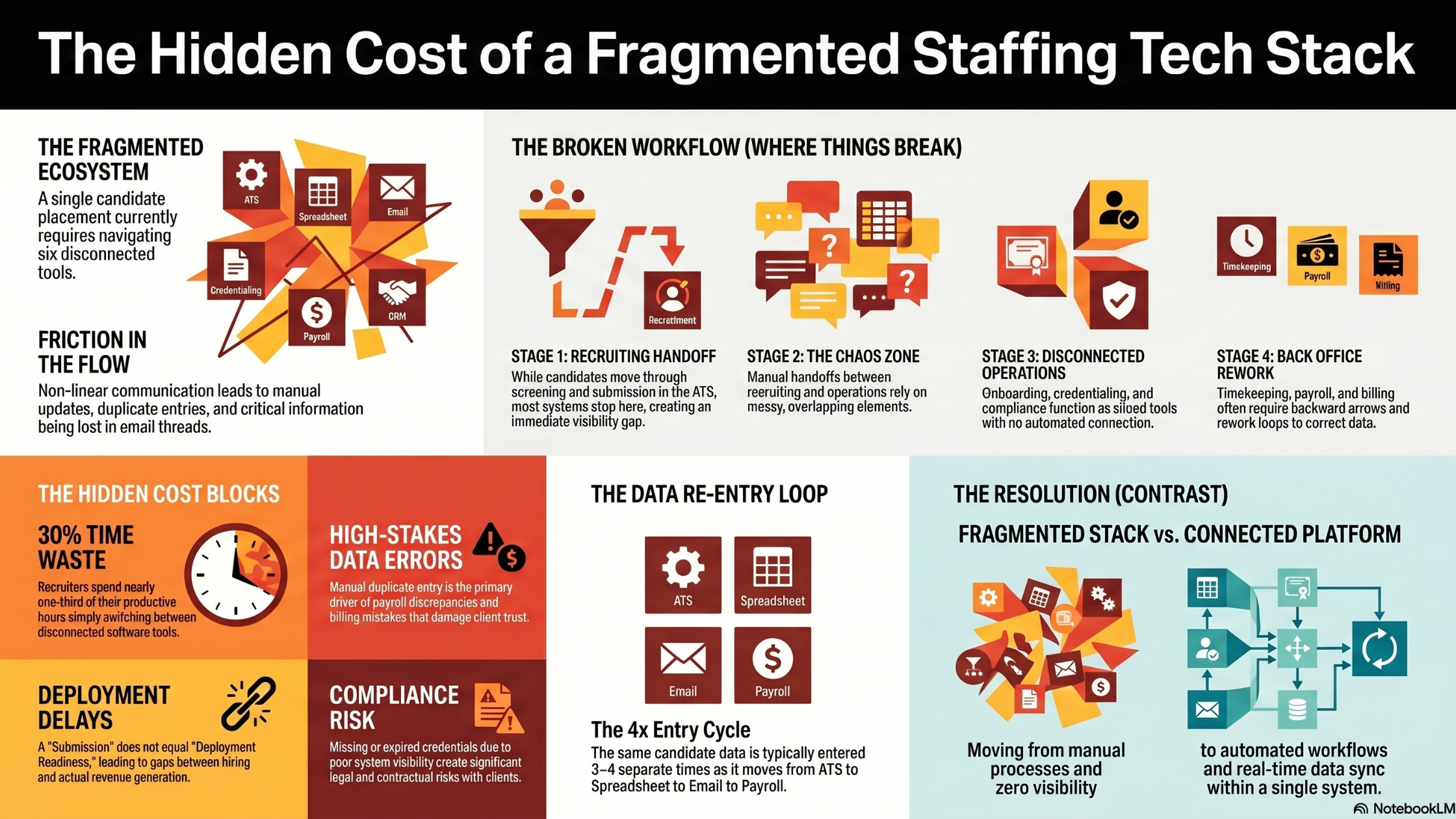
What usually breaks at scale:
Recruiter closes a job, operations team doesn’t know
Compliance items are tracked on a shared spreadsheet no one owns
Onboarding documents are sent manually, not tracked automatically
Payroll gets wrong rates because billing was set up separately
This is why the right question isn’t just “which ATS has the best resume parsing.” It’s “which platform actually connects recruiting to everything that comes after it.”
ATS for Staffing Agencies 2026: Key Features That Actually Matter
Here’s what separates a platform built for staffing from a generic hiring tool, and why integrated candidate onboarding is the most overlooked of all:
Feature
Why It Matters for Staffing
Multi-client job order management
Recruiters work across accounts simultaneously
Pipeline visibility by a recruiter
Managers need to see activity and bottlenecks
Integrated candidate onboarding
Eliminates the gap between ATS and operations
Credentialing and compliance tracking
Critical for healthcare, light industrial, and professional staffing
Automated communication workflows
Keeps candidates engaged without manual follow-up
Payroll and billing connection
Placement data flows directly to back office
Reporting by client, job order, and recruiter
Gives owners actual operational visibility
Mobile access for candidates
Speeds up document submission and onboarding
See how staffing compliance tracking works inside a connected platform, and how it changes the daily workload for your operations team.
Pro tip for staffing agencies: If your ATS doesn’t have a direct connection to your onboarding workflow, your operations team will build one out of email templates and spreadsheets, and it will break every time volume increases.
Why Most Standard ATS Platforms Fall Short for Staffing Agencies
Platforms like Bullhorn, Zoho Recruit, Crelate, and others are legitimate tools, and each has real strengths. But every agency owner who has used them will tell you the same thing: they require significant configuration, third-party integrations, and manual process design to cover what a staffing agency actually needs end-to-end.
Bullhorn is powerful but expensive to configure, and the UX has a steep learning curve for newer recruiters. At scale, it works, but getting there requires real onboarding investment.
Zoho Recruit is strong on CRM and client portal features but requires heavy customization to match staffing-specific workflows.
Generic ATS platforms built for corporate HR miss the entire back half of the staffing lifecycle: credentialing, deployment readiness, timekeeping, and billing.
The real cost of these gaps isn’t just software. It’s the recruiter time, operations errors, and compliance risk that accumulate when your tools don’t talk to each other.
For agencies evaluating alternatives, the staffing software comparison guide breaks this down further.
What Actually Changes When Agencies Fix This: A Real Example
One healthcare staffing firm, Tucker Staffing, thought they needed more recruiters. What they actually needed was better system alignment between their ATS and the rest of their operations.
After restructuring their workflow around an integrated staffing platform instead of a standalone ATS, they saw:
30% increase in fill rate from automated candidate-to-deployment handoffs
25 hours saved weekly through integrated payroll and billing, no more re-entering placement data
50% reduction in administrative tasks across recruiting and operations
94% staff adoption of their white-labeled mobile app for candidate engagement
2,000+ organic leads generated through their branded mobile presence
Key takeaway for operations leaders: The change did not come from working harder or hiring more recruiters. It came from removing the operational friction between sourcing, credentialing, and payroll, exactly the gap a standalone ATS leaves open.
How Join Vars Approaches ATS Differently for Staffing Agencies
Join Vars (joinvars.com) is a staffing software platform built specifically for agencies. The ATS module inside Join Vars isn’t a standalone product. It’s one part of a connected operational system that covers the full staffing lifecycle.
Here’s how that plays out in practice:
Does the ATS Connect to Candidate Onboarding Automatically?
In most agencies, a recruiter closes a job, sends a “congrats” email, and then manually notifies the onboarding team. That handoff takes time, introduces errors, and creates a communication gap that the candidate notices.
In Join Vars, when a candidate moves to the placement stage in the ATS, onboarding is triggered automatically. The candidate receives their document checklist. The operations team is notified. Compliance requirements tied to that client or role are surfaced automatically.This is the difference between a hiring tool and an operational platform.
How Does Join Vars Handle Credentialing Inside the ATS Workflow?
For healthcare staffing agencies especially, credentialing is the bottleneck that controls whether a candidate deploys on time. Most ATS platforms have no credentialing functionality, so you manage it separately.
Join Vars includes a Credentialing module, part of its healthcare staffing software, that tracks license status, expiration dates, document uploads, and compliance requirements, all tied directly to the candidate record inside the platform. Recruiters can see at a glance whether a candidate is credential-complete, not just whether they’ve been submitted.
Key takeaway for operations leaders: When credentialing lives inside the same platform as your ATS, your time-to-deploy shrinks. Not because the process is shorter, but because no one has to chase the status across systems.
For healthcare agencies specifically, see how the healthcare applicant tracking system buyer’s guide addresses this in detail.
What Happens After Placement, Scheduling, Timekeeping, and Payroll?
A traditional ATS ends at placement. Join Vars doesn’t.
Once a candidate is placed, the platform connects to:
Staffing & Scheduling to assign shifts and manage deployments
Timekeeping to capture hours worked against the right client and job order
Payroll & Billing where timesheet data flows directly into pay runs and client invoices
This means the placement data your recruiter entered in the ATS doesn’t need to be re-entered by payroll. The bill rate, start date, client code, it all carries through.
One operations lead at a mid-size travel staffing agency told us: the biggest time savings wasn’t in the ATS itself. It was in eliminating the 3 to 4 touchpoints between a recruiter’s placement and the first paycheck going out accurately.
Does Join Vars Have AI Recruiting Tools Built Into the ATS?
Yes. Join Vars includes several AI-powered features that sit directly within the recruiting workflow:
Vars AI Now surfaces actionable insights and candidate recommendations in real time
AI Voice Recruiter handles initial candidate outreach and screening via voice, reducing recruiter call volume on high-volume requisitions
AI Candidate Matching ranks candidates against job requirements to help recruiters prioritize the right people faster
These aren’t add-on features from a third-party integration. They’re built into the platform, which means your recruiters access them without switching tools or re-entering data.
What About Agencies That Need a White Label or Client-Facing Portal?
Join Vars offers a White Label Mobile App that agencies can brand as their own. Candidates interact with the agency’s branded experience, submitting documents, checking status, and receiving communications, while the backend is fully managed through Join Vars.
For agencies building their brand in specific markets (healthcare, light industrial, professional services), this matters. A branded app experience signals to candidates that you’re an established, organized operation.
Comparing ATS Options for Staffing Agencies: A Practical Framework
Before you commit to any platform, walk through this decision framework:
What to evaluate first:
Does the ATS connect directly to onboarding, or does that require a separate tool?
How does credentialing and compliance tracking work, is it built-in or an add-on?
Can the platform handle multi-client job orders without heavy manual configuration?
What does the handoff to payroll and billing look like from a placement record? For a deeper look at how payroll integration works in practice, the payroll software for staffing agencies guide covers the key variables.
What level of implementation support is included, and what does it cost?
What to fix first vs. later:
Fix first: Recruiter-to-operations handoff process. This is where the most errors and delays happen, and it’s where the right ATS immediately improves productivity.
Fix later: Advanced reporting, AI matching optimization, and mobile app branding. These matter, but they won’t deliver value until your core workflow is solid.
What usually breaks at scale: Agencies that automate recruiting but leave onboarding and compliance manual hit a wall when volume increases. The bottleneck just moves downstream.
How Does an Integrated Staffing Platform Compare to a Basic Recruitment CRM?
A lot of the confusion agencies run into when comparing ATS options for staffing agencies comes down to comparing tools that are not solving the same problem. A recruitment CRM is built to track candidates and client relationships. An integrated staffing platform is built to run the entire placement lifecycle, including everything the CRM leaves out.
Operational Area
Basic Recruitment CRM
Integrated Staffing Platform
Resume & candidate tracking
Yes
Yes
Client relationship management
Partial
Full
Credential & license alerts
Manual
Automated
Compliance dashboard
No
Yes
Scheduling
Limited or none
Integrated
Payroll & billing
External system
Connected
Deployment readiness visibility
Low
High
If your only goal is building a candidate database, a CRM can be enough. If your goal is improving fill rate, reducing administrative overhead, and protecting margins across the full placement-to-payroll cycle, the gap between the two becomes the deciding factor.
Frequently Asked Questions: ATS for Staffing Agencies 2026
How long does it take to implement an ATS for a staffing agency?
For a platform like Join Vars that covers recruiting, onboarding, and back office in one system, most agencies are operational within a few weeks. The more complex your existing data and workflows, the longer data migration takes, but the core functionality can typically be live and running much faster than traditional enterprise ATS deployments.
What’s the difference between an ATS and staffing software?
An ATS tracks candidates from application to hire. Staffing software handles the full operational cycle: sourcing, recruiting, credentialing, onboarding, scheduling, timekeeping, payroll, and billing. If your agency only hires for internal roles, an ATS is sufficient. If you’re placing candidates at client companies and managing back-office operations, you need a platform built for staffing. For a detailed breakdown, read what is staffing software and how it differs from ATS.
Can a small staffing agency benefit from staffing software like Join Vars?
Yes, often more than large agencies, because small agencies can’t afford dedicated operations staff to manually bridge system gaps. A connected platform reduces the administrative burden on each team member significantly, which directly impacts your capacity to fill more roles without adding headcount.
What ATS features actually matter for healthcare staffing compliance?
For healthcare specifically, credentialing tracking, license expiration alerts, compliance document management, and client-specific requirement mapping are non-negotiable. A generic ATS won’t cover these. Look for a platform where compliance tracking is connected to the candidate record, not managed on a separate spreadsheet. See how workforce compliance software for staffing agencies addresses these requirements. Agencies placing nurses, allied health professionals, or travel clinicians also need multi-state licensing checks, OIG exclusion screening, immunization and background-check tracking, and travel-contract compliance built into the same workflow rather than tracked separately in spreadsheets. When those checks live inside the ATS, recruiters can see deployment readiness at a glance instead of chasing status updates across systems.
Is there an ATS for staffing agencies that includes payroll and billing?
Yes. Join Vars connects the ATS directly to payroll and billing, so placement data flows through to timekeeping and invoicing without manual re-entry. This is one of the most impactful operational improvements agencies report when switching from a standalone ATS.
How do I evaluate whether my current ATS is the right fit?
Map the journey from “candidate submitted” to “first paycheck sent.” Count how many systems, emails, and manual steps your team touches along the way. If the answer is more than two or three handoffs, your current stack has a fragmentation problem, and the ATS is only solving part of it.
What is the best ATS for staffing agencies in 2026?
There’s no single answer that fits every agency. But the clearest differentiator in 2026 is whether the platform handles recruiting and the operational lifecycle after placement. For agencies that need that full-stack capability, especially in healthcare, professional, or high-volume staffing, Join Vars is worth a serious evaluation.
Is Join Vars an ATS for recruiting agencies too, or just staffing agencies?
Both. The workflow challenges are the same whether you call yourselves a staffing agency or a recruiting agency: sourcing, screening, submitting candidates, and keeping clients updated without the process falling apart as volume grows. Join Vars gives recruiting agency teams a centralized candidate database, automated communication workflows, and a client-facing portal, alongside the same credentialing and payroll connections staffing agencies rely on.
Final Takeaway for Agency Owners
The right ATS for your staffing agency in 2026 isn’t the one with the most features on a comparison grid. It’s the one that eliminates the most manual steps between a recruiter’s placement and a deployed, compliant, paid worker.
One realistic next step you can take today: Map your current workflow from candidate submission to deployment. Write down every system, email thread, and manual step your team uses. That map will tell you exactly where your current tools are creating friction, and what to prioritize when evaluating any new platform.
If you’re ready to see how Join Vars handles that full workflow, visit joinvars.com to learn more, or book a demo to see the platform in action.
Frequently Asked Questions
What does a staffing agency actually need from an ATS in 2026?
Beyond resume parsing, agencies need an ATS that connects directly to onboarding, credentialing, scheduling, and payroll so a placement does not stall between systems.
Does the ATS connect to candidate onboarding automatically?
In a purpose-built staffing platform, yes. Once a candidate is placed, their record should flow straight into onboarding and credentialing without manual re-entry.
Is this ATS for recruiting agencies or only staffing agencies?
Both. Join Vars supports the same core workflow, sourcing, screening, submission, and client updates, whether your team calls itself a staffing agency or a recruiting agency, with credentialing and payroll connections built in.