
Best ATS for Job Board Integration: Top Picks (2026 Guide)
- Feb 26
- 5 min read

When agency leaders search for the best ATS for job board integration, they are rarely trying to solve a marketing problem.
They are trying to fix workflow drag.
It usually starts with a small irritation. Recruiters are spending too much time reposting jobs. Compliance keeps asking for missing documents. Operations does not trust the candidate status in the system. Finance is double-checking deployment readiness before payroll runs.
Individually, none of these feels catastrophic.
Together, they slow growth.
In 2026, job board integration is less about how many platforms you connect to and more about whether your recruiting engine actually feeds the rest of your operation cleanly.
What Really Happens After a Candidate Applies?
Most comparison guides stop at distribution. That is surface-level.
The real question is what happens after someone clicks Apply.
I worked with a regional healthcare staffing firm that had no shortage of inbound applicants. Jobs were posted across major boards and niche platforms. Application volume looked healthy on paper.
Yet placements were not accelerating.
After sitting with their operations lead, the issue became obvious:
Recruiters were screening inside one tool.
Credentialing tracked documents in a shared drive.
Compliance maintained its own spreadsheet.
Scheduling operated off email confirmations.
Nothing was technically broken. It just was not aligned.
By the time a candidate reached deployment, small gaps had compounded into delays.
That is why the best systems for integrating with job boards must create structure downstream, not just automate posting upstream.
Where Agencies Quietly Lose Margin
There are two friction points that do not show up on dashboards.
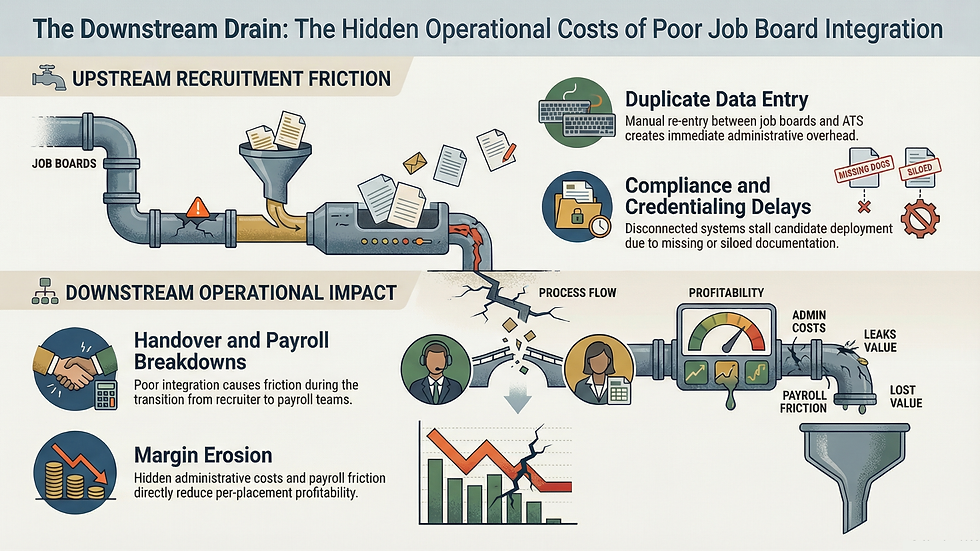
First, duplicate entry.
When applicant data imports without structured fields, recruiters end up re-tagging specialties, rewriting notes, and manually checking license status. It seems minor. But multiply that by 40 active roles and three recruiters.
Second, handoff ambiguity.
Recruiters mark someone as qualified. Credentialing later flags missing immunization documentation. Deployment gets pushed. Finance adjusts billing forecasts.
No one blames the ATS. But the integration was shallow.
What usually breaks at scale is visibility between teams.
What the Best ATS for Job Board Integration Should Actually Deliver
Strip away marketing language and focus on operational capability.
A strong system should allow recruiters to post across multiple job boards from one environment without formatting inconsistencies or expiration tracking headaches. That part is expected.
More importantly, once applications land, they should enter a structured pipeline where:
Screening criteria are standardized
Disqualifiers are visible early
Specialty tags are consistent
Source attribution remains intact
If recruiters are relying on memory or personal note styles, the system will not scale.
In healthcare staffing, screening also needs to reflect compliance reality. License verification, background checks, vaccination records, facility requirements. If that visibility does not exist during screening, time-to-deploy will suffer regardless of how fast jobs are posted.
Integration must extend beyond recruiting.
Where Join Vars Fits Into the Real Workflow
Join Vars is a workforce management software built for agencies that need continuity from application to invoice.
The difference shows up in the handoffs.
When job board applications feed directly into the Join Vars Applicant Tracking System, recruiting does not operate in isolation. Candidate status, documentation progress, and readiness indicators exist in one shared environment.
One agency that implemented a white-labeled mobile app through Vars reported a 30% increase in fill rate after consolidating workflows. They also generated more than 2000 organic leads because their brand had a direct mobile presence instead of relying entirely on third-party platforms.
Another leadership team shared that integrating payroll and billing modules saved roughly 25 hours per week in administrative coordination. A separate agency reported a 50% reduction in administrative workload and saw 94% staff adoption of the mobile system within months.
Those improvements were not the result of posting automation alone. They came from eliminating fragmentation.
When ATS activity connects to credentialing, compliance, scheduling, and payroll inside one operational framework, visibility improves naturally. Late-stage surprises decline.
That is where margin improves.
How to Evaluate the Best Software for Job Board and ATS Integration
Before you compare vendors, audit your internal friction.
Ask your recruiting lead how much time is spent formatting jobs versus engaging candidates.
Ask your credentialing manager how often documentation gaps are discovered after submission.
Ask finance how often timesheets require correction due to deployment misalignment.
The answers will tell you more than a feature grid.
A strong system should remove duplicate entries, clarify stage ownership, and surface readiness indicators in real time.
It will not fix undefined processes. But it will expose them quickly.
What to Fix Before Switching Systems
Agencies sometimes try to automate before standardizing.
That creates resistance.
Start by defining:
What qualifies a candidate as submission-ready
What defines deployment-ready
Who owns each stage
What compliance requirements vary by specialty
Then evaluate the best ATS for job board integration based on whether it supports those realities.
Technology amplifies clarity. Without clarity, it amplifies confusion.
Mistakes Agencies Make During ATS Upgrades
Over the years, the same patterns repeat.
Some agencies purchase separate ATS and payroll tools that do not speak to each other. Others allow recruiters to customize workflows so heavily that reporting becomes meaningless. Many underestimate the operational complexity of compliance tracking in multi-state healthcare staffing.
The result is temporary excitement followed by operational fatigue.
Alignment must be intentional.
FAQ: Best ATS for Job Board Integration
What is the best ATS for job board integration for staffing agencies?
It is the system that centralizes job distribution while structuring what happens after the application. Depth of integration across recruiting, compliance, onboarding, and payroll matters more than the number of boards supported.
How does applicant screening software impact time-to-deploy?
It is the system that centralizes job distribution while structuring what happens after application. Depth of integration across recruiting, compliance, onboarding, and payroll matters more than the number of boards supported.
Can smaller agencies justify investing in integrated ATS platforms?
Yes. Smaller teams often rely on manual coordination. Integrated systems reduce administrative overhead and prevent growing pains as volume increases.
How long does implementation typically take?
If workflows are clearly defined, implementation can move quickly. If processes are fragmented, mapping and alignment may take longer than the software configuration itself.
What features matter most in healthcare staffing environments?
Credential tracking, compliance visibility, license validation indicators, readiness dashboards, and payroll alignment are critical. Without those, job board integration remains surface-level automation.
Final Thoughts
Choosing the best ATS for job board integration is not about automation for its own sake.
It is about whether your recruiting engine feeds the rest of your operation cleanly.
Before selecting a system, map your workflow from job posting to first invoice. Identify where duplication occurs, where visibility disappears, and where delays surface.
Then choose software that removes those specific friction points.
The agencies that scale sustainably are not the ones posting on the most job boards. They are the ones operating with structured visibility from sourcing through billing.


Comments