
Best Hospitality Staffing Software for Hotels, Restaurants & Resorts
- 4 days ago
- 10 min read
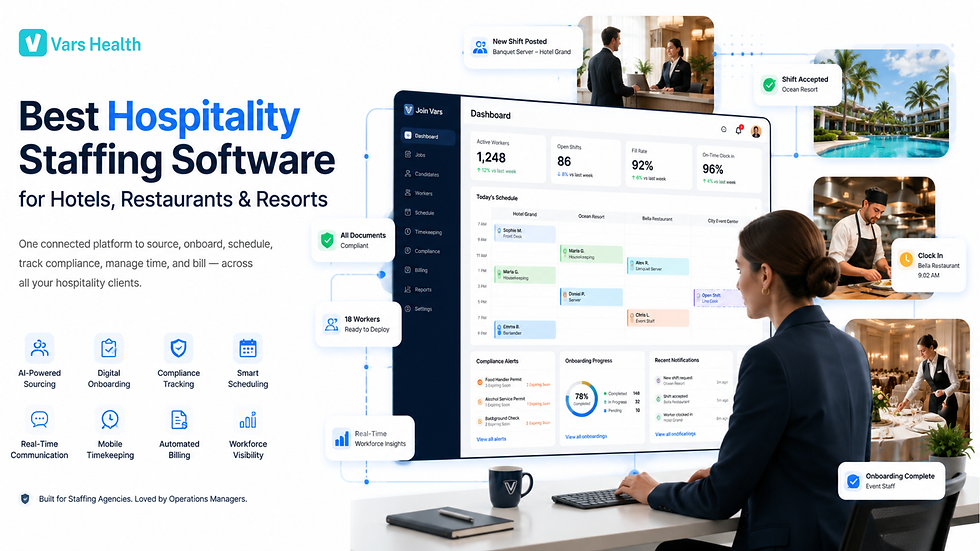
If you run staffing operations for hotels, restaurants, or resorts, you already know the core challenge: hospitality never slows down, but your back-office tools usually do. Hospitality staffing software exists to close that gap, giving operations managers one place to source, onboard, schedule, track compliance, and manage payroll. The key is having all of it run inside a single staffing software platform built for this exact workflow.
Why Is Hospitality Staffing Uniquely Difficult to Manage?
Most industries deal with hiring and scheduling. Hospitality deals with all of that simultaneously, at scale, across roles with wildly different requirements and with zero tolerance for gaps in coverage. A front desk understaffed at peak check-in, a kitchen missing a line cook on a Friday night, or a resort short on housekeeping during a holiday weekend creates immediate guest experience problems that show up in reviews within 24 hours.
In practice, the staffing challenges in hospitality fall into a few recurring categories:
Extreme seasonality: properties need to surge from 40 staff to 200 within weeks, then scale back down
High turnover rates: the hospitality industry consistently sees annual turnover above 70%, making continuous recruiting non-negotiable
Multi-role, multi-property complexity: a single staffing agency may be covering front desk, F&B, housekeeping, banquets, and event staff across a dozen properties simultaneously
Compliance exposure: food handler certifications, alcohol service permits, background checks, and local labor law compliance all need to be tracked per worker, per role
Last-minute shift changes: no-shows, callouts, and schedule swaps happen daily, and there's no time for email chains. Agencies handling this volume need a purpose-built on-demand staffing solution that responds in real time.
⚠ WHAT USUALLY BREAKS AT SCALE |
When agencies start managing 5+ hospitality clients at once, the first thing to collapse is onboarding consistency. Workers are cleared for one property but not tracked correctly for another. Compliance documents expire unnoticed. The bottleneck is almost never a shortage of candidates; it's the operational infrastructure that can't keep pace. |
What Should Hospitality Staffing Software Actually Do for an Operations Manager?
There's a lot of software marketed to hospitality operators, property management systems, shift schedulers, and payroll tools. But if you're running a staffing agency that serves hospitality clients, your needs are different. You're not just scheduling your own employees, you're managing a pipeline of contract workers, tracking their readiness across multiple client properties, and billing accurately for every shift worked.
Here's what a platform built for this use case should deliver:
Operational Area | What You Need | Without It |
Candidate Sourcing & ATS | Centralized pipeline from job post to offer, managed through an AI-powered applicant tracking system with skill tagging by role. | Recruiters track candidates in spreadsheets or separate inboxes |
Onboarding | Digital, self-serve candidate onboarding with document collection configured per role and property. | Paper packets, manual follow-up, slow time-to-deploy |
Compliance & Credentialing | Automated workforce compliance tracking covering food handler certs, I-9s, background checks, and credential expiration alerts. | Compliance gaps discovered after the placement of liability risk |
Scheduling | Staffing and scheduling software with drag-and-drop shift builder, coverage gap detection, and auto-fill for open shifts. | Operations managers spend 2–3 hours daily on manual scheduling |
Communication | Push notifications, SMS, and in-app messaging for shift offers and reminders | Phone calls, WhatsApp threads, missed shift confirmations |
Timekeeping & Billing | Mobile clock-in/out with geofencing via the timekeeping and billing module, automated time sheets, and client invoicing. | Manual timesheets, billing disputes, payroll errors |

💡 PRO TIP FOR OPERATIONS MANAGERS |
Before evaluating any platform, map your current workflow from first contact with a candidate all the way to their first invoice. Wherever you're copying data between systems or sending manual follow-up emails is where your biggest efficiency gain lives. |
How Does Join Vars Handle the Full Hospitality Staffing Workflow?
Join Vars is a staffing software platform built for agencies that manage complex, high-volume hospitality workforce needs. Rather than buying five separate tools, an ATS, a scheduler, a compliance tracker, a timekeeping app, and a payroll tool, and trying to integrate them, the platform runs all of it from one place. Here's how that plays out operationally:
🎯 AI-Powered ATS: Source and track candidates with AI candidate matching. Tag candidates by role: banquet server, front desk, line cook, and surface the right person for each open shift.
📋 Candidate Onboarding: Configurable onboarding workflows by property and role. Workers complete paperwork digitally from their phones. Operations teams see exactly who is ready to deploy and who still has steps outstanding.
✅ Compliance & Credentialing: Automatically collect food handler certs, alcohol permits, and background check documents through automated credentialing and employee attestation built into the platform workflow.
📅 Staffing & Scheduling: Drag-and-drop scheduler with gap detection. Set auto-fill rules so eligible staff can claim shifts directly or require manager approval for higher-risk roles.
💬 Real-Time Communication: Push shift offers, confirmations, and reminders instantly. Staff responds directly in-app. No more SMS threads and missed confirmations.
⏱ Timekeeping & Billing: Geofenced clock-in from the mobile app. Automated time sheets feed directly into billing, resulting in accurate invoices without manual reconciliation.
🔑 KEY TAKEAWAY FOR OPERATIONS LEADERS |
The value of an all-in-one platform isn't just convenience; it's data continuity. When your ATS, onboarding, scheduling, and timekeeping are in one system, you can see exactly how long it takes to go from application to first deployed shift. That visibility is what makes operational improvement measurable. |
How Do Hospitality Staffing Agencies Manage Onboarding at Scale Without Slowing Down Deployment?
In a recent implementation with a hospitality staffing agency managing hotel properties across multiple states, the single biggest pain point wasn't finding candidates it was the time between offer acceptance and first deployed shift. Workers were accepting offers but sitting idle for days, sometimes weeks, while paperwork was tracked down manually.
The operational fix wasn't hiring more compliance coordinators. It was restructuring onboarding into a self-serve digital flow where the worker could complete all steps from their phone, uploading documents, signing agreements, and completing required certifications while operations staff got real-time visibility into exactly where each person was in the process.
With Join Vars, onboarding workflows are configured per property and role type. A banquet server has a different onboarding checklist than a front desk associate. The platform handles both without requiring manual oversight of every step. This is how modern employee onboarding software fundamentally changes time-to-deploy operations managers see a dashboard of deployment readiness across all candidates, no spreadsheet required.
⚠ COMMON OPERATIONAL MISTAKE |
Agencies often invest in recruiting tools but leave onboarding as a manual, email-driven process. This creates a bottleneck right before deployment, erasing the time savings from faster sourcing. Onboarding is where time-to-deploy is either protected or lost. |
Can Hospitality Staffing Software Actually Reduce Compliance Risk Across Properties?
Compliance in hospitality staffing isn't uniform. A food service worker placed at a hotel restaurant needs an active food handler certification. A bartender at a resort may need a state-specific alcohol service permit. A worker placed for an event at a licensed venue may need a background check that meets the client's insurance requirements. Managing all of this manually across dozens of workers and multiple properties is where agencies most frequently face liability exposure.
The problem is usually not that agencies don't know what's required. It's that credential tracking lives in spreadsheets or email folders, and when a document expires mid-engagement, nobody finds out until something goes wrong.
Join Vars handles this with automated credentialing and employee attestation built directly into the platform workflow. Each worker's documents are stored in the platform. Expiration dates trigger alerts before credentials lapse. For a deeper look at how this is managed at scale, see how workforce compliance software for staffing agencies handles credential tracking operationally.
How Does Hospitality Staff Scheduling Work for Agencies Managing Multiple Client Properties?
Scheduling for hospitality staffing agencies is fundamentally different from scheduling for a single venue. You're not just building one property's schedule; you're matching eligible workers to shifts across multiple clients, managing availability windows, preventing double-bookings, and handling last-minute replacements in real time.
The drag-and-drop scheduling module in Join Vars is built with this complexity in mind. For a broader view of how staffing scheduling software benefits agencies across industries, the operational case is consistent. Shifts are created per property. Eligible workers are surfaced based on role, availability, and current compliance status. You can set rules that determine which shifts workers can self-claim and which require manager confirmation.
When a shift opens up at short notice, the platform sends real-time push notifications to eligible workers. Whoever claims it first is confirmed. The operations team sees it close in the dashboard without making a single phone call.
💡 PRO TIP FOR STAFFING TEAMS |
Configure role-based scheduling rules early during implementation. Defining which staff types can auto-accept shifts versus which require approval saves significant manager time during high-volume periods, especially during peak season surges. |
Is a White-Label Mobile App Worth It for Hospitality Staffing Operations?
For hospitality staffing agencies that want to build brand equity with both clients and workers, a white-label mobile app changes the experience significantly. Instead of workers using a generic platform, they're engaging with your agency's branded app with your name, your colors, your communications.
Practically, the app gives workers the ability to complete onboarding, apply for shifts, clock in and out, and receive notifications all in one place. Geofencing on clock-in prevents workers from punching in before they arrive on-site, which directly reduces payroll disputes and billing inaccuracies for your hotel and restaurant clients.
Join Vars offers a custom white-label staffing agency mobile app available on both the App Store and Google Play, configured to match your agency's brand. For larger agencies managing hundreds of active workers across multiple properties, this is one of the highest-leverage investments in the platform because it improves worker engagement, reduces no-shows, and gives operations visibility into real-time attendance without phone calls.
What Does the Transition from Spreadsheets to Staffing Software Actually Look Like?
The question operations managers often ask, rightly, is not whether software is better than spreadsheets. It obviously is. The real question is: what breaks during the transition? This is the core question behind digital transformation in staffing agencies, and the answer depends heavily on implementation sequence.
Here's an honest breakdown of what the transition typically involves:
Weeks 1–2: Platform configuration, setting up your property list, role types, onboarding workflows, and compliance requirements. This is where most of the setup effort lives.
Weeks 3–4: Migrating active worker records and historical data. The team learns the scheduling module and runs it in parallel with the existing system.
Month 2: First live scheduling cycles run through the platform. Compliance tracking is active. Timekeeping begins generating data for billing.
Month 3+: Full operational visibility. You can see time-to-deploy, shift fill rates, and compliance status across the full worker pool in real time.
🔑 WHAT TO FIX FIRST VS. LATER |
Start with onboarding and compliance; these have the highest risk exposure and the most immediate ROI. Scheduling optimization and billing automation come next. AI candidate matching and advanced analytics are a later-stage unlock once your data history builds. |
See How Join Vars Works for Hospitality Staffing |
Get a walkthrough of the platform onboarding, scheduling, compliance, timekeeping, and billing built specifically for staffing agencies serving hotels, restaurants, and resorts. |
Frequently Asked Questions
How long does it take for a hospitality staffing agency to implement staffing software?
Most agencies are operationally live within 30–45 days. The core setup, configuring properties, role types, and onboarding workflows, takes 1–2 weeks. Compliance tracking and scheduling reach full effectiveness by the end of month two, once your worker records are fully migrated.
What compliance documents does hospitality staffing software typically track?
At minimum: food handler certifications, alcohol service permits (state-specific), background check clearances, I-9 employment eligibility, and signed work agreements. Platforms like Join Vars let you configure required documents per role and property, with automatic expiration alerts before credentials lapse.
Can smaller hospitality staffing agencies with under 50 active workers benefit from this kind of platform?
Yes, and often more quickly than larger agencies. The ROI at a smaller scale comes from eliminating manual onboarding follow-up and scheduling time. The compliance benefit is also significant regardless of size: a single compliance gap creates the same liability exposure whether you manage 20 workers or 200.
How does geofenced timekeeping reduce billing disputes with hotel and restaurant clients?
When workers clock in via a geofenced mobile app, the system records actual on-site start and end times, not self-reported times. This creates an auditable record that matches your billing. Clients can verify hours worked against the time log, which eliminates the back-and-forth that comes with manual or self-reported timesheets.
Does Join Vars handle both contract and permanent hospitality staffing workflows?
Yes. The platform supports contract, contract-to-permanent, and permanent placements. Scheduling and timekeeping are primarily relevant for contract and temporary placements, while the ATS and onboarding modules support permanent hiring as well.
What is the difference between using a generic HR platform and hospitality-specific staffing software?
Generic HR platforms are built for managing a single employer's workforce. Staffing software is built for agencies managing workers across multiple client locations, roles, and compliance requirements simultaneously. The key difference is that the multi-client architecture of a staffing platform tracks compliance and billing separately per client, and handles shift assignment across properties in a way that generic HR tools are not designed to do.
Can the mobile app be branded with our staffing agency's name and logo?
Yes. Join Vars offers a white-label mobile app that can be configured with your agency's branding name, logo, and color scheme, available on the App Store and Google Play. Workers interact entirely within your branded environment, which improves engagement and reinforces your agency's identity with both workers and clients.
Conclusion: Where to Start If You're Running Hospitality Staffing Today
If you're still managing onboarding via email, tracking credentials in spreadsheets, and building schedules manually, the operational ceiling is lower than it needs to be, and the compliance risk is higher than it should be. Hospitality staffing moves too fast for fragmented tools.
The clearest first step is an honest workflow audit. Take one recent placement from application to first billable shift and trace every step manually. Count how many tools were touched, how many emails were sent, and how many steps required a human to follow up. That audit will show you exactly where software changes the equation and where process discipline is also needed.
The software won't fix a broken process on its own. But with the right platform in place, one that connects sourcing, onboarding, compliance, scheduling, timekeeping, and billing into a single operational layer, your team spends less time managing logistics and more time actually staffing. That's what hospitality clients hire you to do.
If you want to see how Join Vars handles this end-to-end, book a walkthrough with the team.
Join Vars Content Team Written by staffing operations specialists at Join Vars, a workforce management software platform built for staffing agencies across hospitality, healthcare, and industrial sectors in the US. |

Comments