
How to Choose the Right Healthcare Staffing Software
- Mar 17
- 5 min read

If you’re actively evaluating healthcare staffing agency software, you’re probably already feeling the friction.
Not in sourcing. Not even in recruiting.
It usually shows up right after a candidate says “yes.”
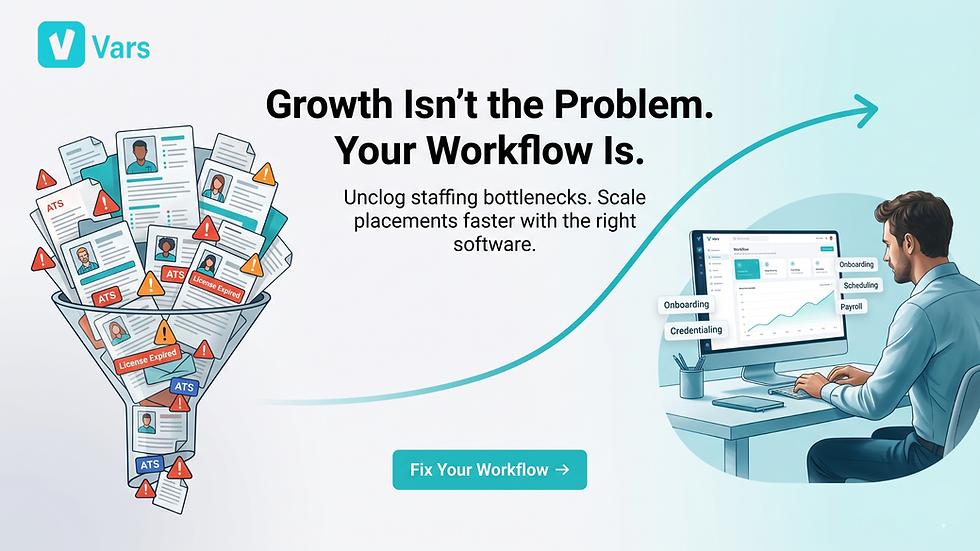
That gap between offer accepted → fully deployable is where most agencies start losing time, money, and trust. And that’s exactly where the right healthcare staffing software either fixes things or makes them worse.
Where do staffing operations actually start breaking down?
Most agency owners don’t wake up one day and decide to buy software.
What usually happens is more gradual and a bit frustrating.
A recruiter fills roles just fine. Then suddenly:
Compliance is chasing missing documents over email
Credentialing is stuck in spreadsheets that no one fully trusts
Operations can’t tell who is actually ready to deploy
Payroll flags errors after shifts are already completed
Nothing is “broken” in isolation.
But together, the system slows down.
One operations manager we worked with described it like this:
“We had candidates in five different statuses depending on who you asked.”
That’s not a sourcing problem.
That’s a visibility problem across the workflow.
What should you evaluate first when choosing healthcare staffing software?
Most demos will walk you through features.
That’s not where the decision should start.
Before you look at any platform, you need to get brutally honest about your current workflow.
Not the ideal version, the real one your team follows under pressure.
Map what actually happens (not what should happen)
Try this exercise:
When a recruiter submits a candidate, what happens next?
Who owns credentialing, and how do they track progress?
Where do delays typically sit? (Not where you think, where they actually sit)
How many tools are involved before someone becomes deployable?
You’ll usually find:
Duplicate data entry
Status confusion
Manual follow-ups
Hidden bottlenecks between teams
Pro tip for staffing agencies:
If your process depends on “checking with someone,” your system is already leaking time.
Which features actually matter and which ones don’t (at least not yet)?
A lot of platforms will sell you breadth.
In practice, depth in a few areas matters more.
The features that directly impact revenue
These are the ones tied to time-to-deploy and accuracy:
ATS (Applicant Tracking System): Not just storing candidates, but making recruiter pipelines usable
Credentialing & compliance tracking Especially expiration alerts and document completeness
Structured onboarding workflows, so candidates don’t get stuck in “almost ready.”
Scheduling/deployment visibility: Knowing who can be placed now, not tomorrow
Timekeeping + payroll alignment. This is where revenue leakage quietly happens
What agencies often over-prioritize
Fancy dashboards
Overbuilt reporting
Excessive customization early on
These matter, but only after your core workflow is stable.
Common operational mistake:
Trying to fix reporting before fixing the process that generates the data.
Why does credentialing and onboarding slow agencies down so much?
Because it’s treated like a checklist instead of a live workflow.
In reality, credentialing is where deals are either secured or quietly lost.
Here’s what typically happens:
A candidate submits partial documents
The recruiter assumes compliance will handle it
Compliance waits for missing items
No one owns the delay
Meanwhile, the role gets filled by someone else.
What usually breaks at scale
👉 Candidates sitting in a “nearly ready” state with no clear next action
This creates:
Slower placements
Lower recruiter productivity
Frustration on the client side
And the worst part you don’t always see it clearly unless you’re digging manually.
How does the right software actually reduce these delays?
Good medical staffing software doesn’t just store information; it pushes the process forward.
In practice, that looks like:
Tasks are assigned automatically once a candidate enters onboarding
Real-time visibility into missing documents
Alerts before credentials expire (not after)
A single view of candidate readiness across teams
Where Join Vars fits into this workflow
In most agencies we’ve seen, the biggest improvement doesn’t come from adding features.
It comes from removing the gaps between systems.
With Join Vars, the flow is connected:
Recruiters don’t lose visibility after submission
Credentialing isn’t buried in spreadsheets
Operations can instantly see who is deployable
Payroll data ties back to actual worked time
One team we worked with didn’t change their hiring volume at all, but still improved placements.
Why?
Because they reduced the time candidates spent waiting between steps.
That’s usually where the hidden inefficiency lives.
Is AI actually useful in staffing or just hype?
It depends on where you apply it.
There are areas where AI genuinely helps:
Matching candidates to roles faster than manual filtering
Handling initial outreach so recruiters aren’t stretched thin
Prioritizing candidates based on readiness signals
But there are also limits.
AI won’t fix:
Poor internal processes
Miscommunication between teams
Compliance judgment calls
Key takeaway for operations leaders:
AI improves speed, but only after your workflow is already structured.
How do you know it’s the right time to invest in staffing software?
You don’t need to be a large agency.
You need to be experiencing friction that’s becoming repetitive.
Signs usually look like:
Recruiters are spending time on follow-ups instead of placements
Compliance is constantly reacting instead of tracking proactively
Operations lacking a clear deployment pipeline
Revenue impacted by avoidable delays
If your growth feels harder than it should, your systems are probably the reason.
What mistakes should you avoid when selecting a platform?
This is where many agencies get stuck, even after buying software.
The patterns we see repeatedly:
Buying based on features instead of workflow fit
Trying to automate processes that aren’t clearly defined
Ignoring how recruiters actually work day-to-day
Overcomplicating implementation from day one
What tends to work better
Start with the core flow: candidate → ready → deployed → paid
Roll out in phases instead of all at once
Get early buy-in from recruiters and compliance teams
Measure improvements in time-to-deploy, not just usage
Pro tip for staffing agencies:
Adoption is what drives ROI, not feature count.
So how should you choose the right healthcare staffing software?
At this stage, the decision is less about comparison and more about alignment.
A simple way to evaluate:
Does this system reflect how our teams actually work?
Will it reduce the number of handoffs between teams?
Can we clearly see who is ready to deploy at any time?
Does it remove the need for spreadsheets and side-tracking?
Will this still work when we double our volume?
If you hesitate on these, it’s worth digging deeper before committing.
FAQ: Choosing Healthcare Staffing Software
How long does implementation usually take?
For most agencies, somewhere between a few weeks and a couple of months, depending on how complex your workflows are.
What matters most for compliance tracking?
Not just storing documents but:
tracking expirations
ensuring completeness
maintaining audit-ready records
Can smaller agencies benefit from healthcare staffing software?
Yes, especially if they want to grow without constantly adding headcount.
Is it better to use multiple tools or one system?
Multiple tools can work early on, but they often create handoff problems as you scale.
Will software immediately fix operational issues?
No. It will highlight them faster, but you still need to fix the underlying process.
Final thoughts
Choosing the right healthcare staffing agency software isn’t about finding the most advanced platform.
It’s about finding one that fits the way your agency actually operates, especially in the moments where things currently slow down.
If you’re unsure where to start, don’t begin with demos.
Start by mapping:
where candidates get stuck
where communication breaks
where delays cost you placements
From there, the right system becomes much easier to recognize.


Comments