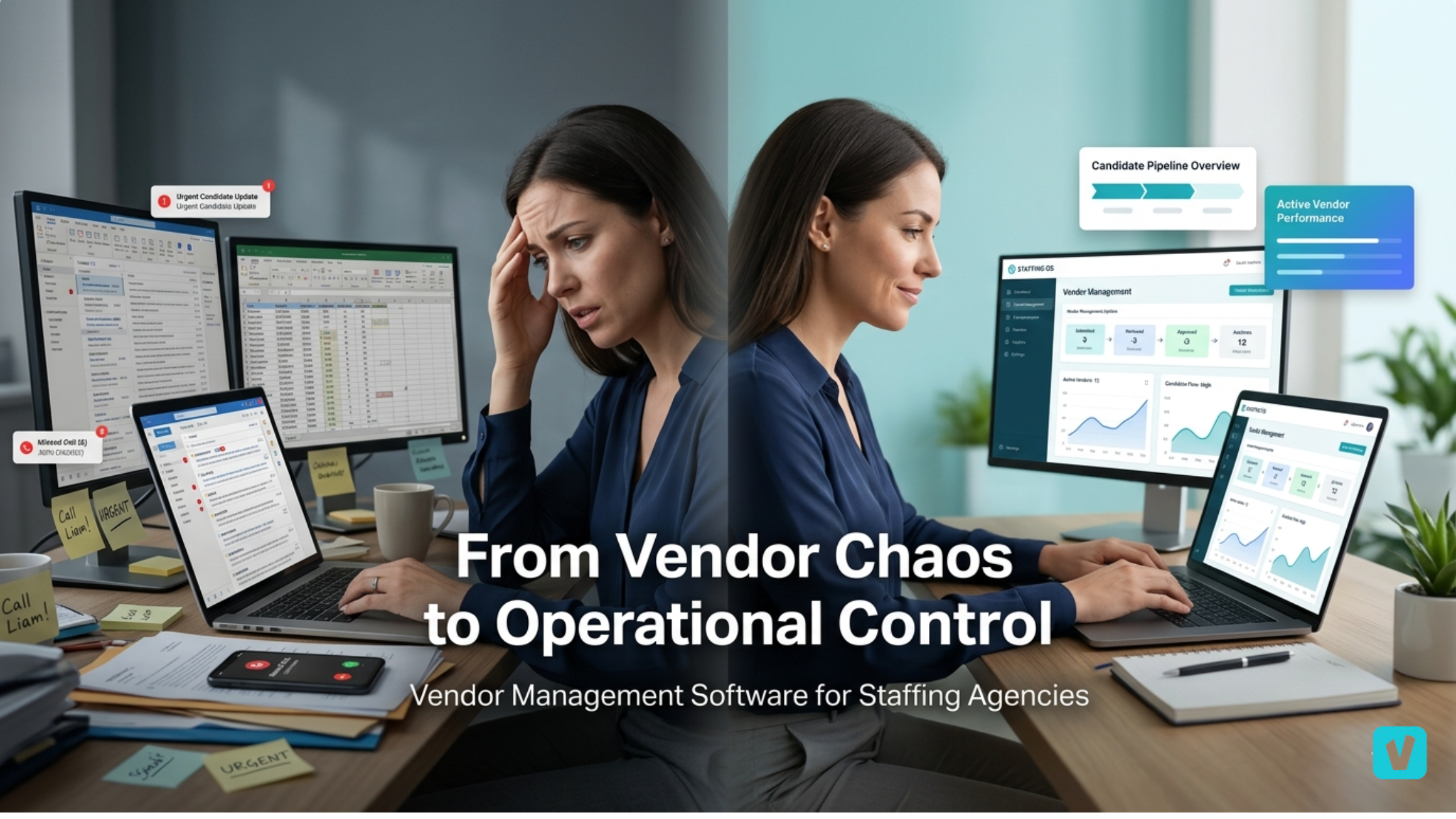
If you’ve managed vendors inside a staffing agency, you don’t need a definition of a VMS.
You’ve already seen the mess:
Resumes are coming from everywhere
Vendors following different formats
Recruiters asking “who owns this candidate?”
Compliance is getting looped in too late
At some point, it stops being a sourcing problem.
It becomes a control problem especially when there’s no centralized staffing workflow management system in place.
That’s usually when agencies start looking at vendor management software, not because it’s trendy, but because things are slipping through the cracks.
Where things actually break without a VMS
Let’s talk about what really happens inside most agencies.
You open your inbox in the morning, and there are:
40+ vendor submissions
Half of them are missing details
Some duplicates
Some have already been reviewed by another recruiter
Now multiply that across a team.
There’s no clean system deciding:
Which candidate moves forward
Who reviewed what
Whether the same profile was already rejected
And nobody fully trusts the data.
That’s the real problem a VMS solves, not vendor management in theory, but chaos in execution.
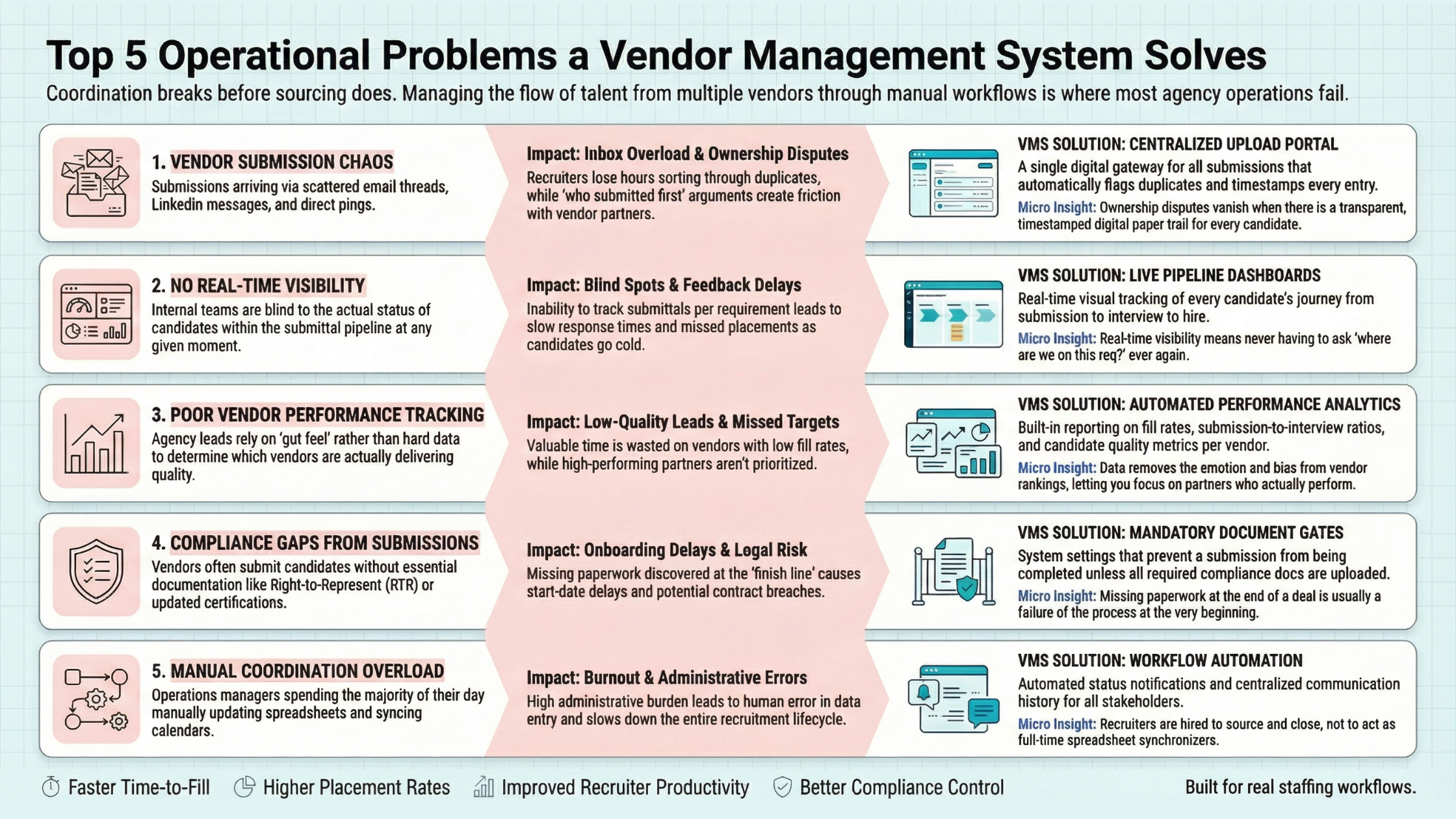
What changes once a VMS is in place?
See how Vars covers this for your agency
Scheduling, credentialing, and payroll in one platform.
It’s not dramatic on day one. But within a few weeks, you notice small shifts.
Vendors stop emailing resumes randomly.
Submissions start coming through a structured channel using a staffing applicant tracking system integrated with vendors.
Recruiters spend less time asking each other for updates.
It doesn’t magically make hiring faster, but it removes friction.
And that friction is what slows everything down.
The biggest benefit agencies notice first: visibility
Not speed. Not automation.
Visibility.
Before a VMS, if you ask:
“How many active vendor submissions do we have right now?”
You’ll get guesses.
After a VMS, you can actually see everything through a real-time staffing analytics dashboard:
How many candidates came in
Which vendor sent them
What stage they’re in
That alone changes how teams operate.
Because once things are visible, they become manageable.
Speed improves, but not the way people expect
Most blogs say “VMS improves time-to-fill.”
That’s true, but not directly.
It doesn’t give you better candidates overnight, but when combined with AI candidate matching for staffing agencies, it improves relevance.
What it does do is remove delays like:
Missed emails
Duplicate screening
Waiting for status updates
So instead of:
“We’ll review and get back tomorrow.”
You get:
“We’ve already reviewed moving forward now.”
It’s subtle. But over weeks, it adds up.
Vendor performance becomes measurable (finally)
This is one of those things agencies think they’re already doing.
They’re not.
Ask most teams:
“Which vendors actually perform best?”
You’ll hear:
“This one is reliable.”
“That one sends volume.”
But rarely actual numbers.
A VMS forces that clarity using vendor performance tracking tools in staffing software.
You start seeing:
Who submits relevant candidates
Who gets interviews
Who actually converts
And sometimes the results are surprising.
Compliance issues don’t show up early until they do
This is where things get risky.
In many agencies, compliance is still reactive.
Everything looks fine until:
A license is expired
A document is missing
A candidate is about to start
Then suddenly, it’s urgent.
A VMS helps by putting structure around it, especially when connected with a staffing compliance management system:
Required fields
Document tracking
Basic validation
It doesn’t eliminate compliance work, but it prevents last-minute surprises.
Cost savings are real but indirect
If you’re expecting a VMS to “cut costs” on paper, you might miss the point.
The real savings show up differently.
Recruiters:
Spend less time coordinating when workflows are supported by staffing automation software
Spend more time actually recruiting
Operations:
Spends less time fixing errors
Spends less time chasing updates
Placements:
Move slightly faster
Happens more consistently
Where most VMS implementations fall short
This part doesn’t get talked about enough.
A VMS on its own doesn’t fix everything.
We’ve seen agencies implement one and still struggle because:
Onboarding is still manual
Compliance is tracked elsewhere
Payroll sits in another system
So even if vendor intake improves, the rest of the workflow is still fragmented.
Where a connected system starts to matter
This is where tools like Join Vars come into the picture, not as a “better VMS,” but as something broader.
Because in real operations, vendor management is just one piece.
Once a candidate is submitted, you still need to:
Onboard them using a digital candidate onboarding system for staffing agencies
Verify credentials through a credentialing software for healthcare staffing agencies
Track compliance
Schedule shifts
Manage timekeeping with a staffing timekeeping and billing system
Handle billing
If those steps live in separate tools, your team is still stitching things together manually.
A connected system reduces that handoff friction through an end-to-end staffing software platform.
Features that actually make a difference
Not everything in a VMS matters equally.
The features that teams actually use daily are usually simple:
Structured submission flow
Clear status tracking supported by staffing communication and workflow tools
Basic performance visibility
Cloud-based vs on-premise (quick reality check)
Most agencies today go with cloud-based systems.
Not because they’re trendy, but because:
Teams are distributed
Vendors are external
Access needs to be flexible
Modern agencies prefer cloud staffing software platforms for scalability and ease of access.
Choosing the right VMS (what actually matters)
If you’re evaluating options, don’t start with features.
Start with your current process.
Look at:
How vendors submit today
Where delays happen
Where information gets lost
Then ask:
“Will this system fix that exact problem?”
You can also review your current staffing software tech stack to identify gaps.
FAQ: Vendor Management Software
What are the key benefits of vendor management software?
Better visibility, structured submissions, improved vendor tracking, and fewer operational gaps.
How does VMS improve procurement efficiency?
It reduces manual coordination and standardizes how vendors interact with your agency.
Can vendor management software reduce costs?
Yes, but mostly through efficiency, not direct cost-cutting.
How does VMS help with risk and compliance?
By ensuring the required data and documents are captured before candidates move forward.
What features matter most?
Submission tracking, visibility, and basic performance insights.
Is VMS useful for smaller agencies?
Yes, especially those transitioning from spreadsheets to digital staffing management systems.
How long does implementation take?
Depends on complexity, but usually a few weeks to a couple of months.
If you’re still evaluating options, see the best vendor management software for staffing agencies in 2026, or start with what a VMS actually is and how it works.
Final takeaway
A VMS doesn’t transform your agency overnight.
What it does is remove the small inefficiencies that quietly slow everything down.
And once those are gone, things start moving better:
Communication becomes clearer
Decisions become faster
Teams spend less time coordinating
If you’re considering it, don’t overthink the technology.
Start simple.
Look at your current vendor flow and ask:
“Where are we losing control?”
Start by mapping a structured vendor intake workflow and reviewing your full staffing operations lifecycle.
Frequently Asked Questions
What changes once a VMS is in place?
The biggest shift agencies notice first is visibility: clear, measurable data on vendor performance, fill speed, and compliance that manual tracking never provided.
Where do most VMS implementations fall short?
Implementations tend to fall short when the underlying staffing agency software cannot keep pace with the VMS reporting and compliance requirements, creating extra manual work rather than less.