
Why AI-Powered Staffing Scheduling Software Is the Future of Workforce Management
- Apr 23
- 8 min read

If you run a staffing agency, you already know the pain: a client calls at 7 a.m. needing six workers for a shift that starts at noon. Your coordinator scrambles through spreadsheets, fires off texts, and crosses fingers someone responds in time. Half of your available workers are already placed. The other half aren’t credentialed for that client. You fill four of the six slots, apologize to the client, and move on to the next fire.
That cycle, reactive, manual, and stressful, is exactly what AI staffing scheduling software like the staffing and scheduling module inside Join Vars is built to break. This article explains how modern scheduling tools are changing the way staffing agencies operate, what features actually matter, and where Join Vars fits into a real agency workflow.
Why Do Staffing Agencies Still Struggle With Scheduling in 2026?
Most agencies have grown their scheduling process organically. It started with a whiteboard, moved to Excel, maybe added a basic calendar tool, and now lives across three or four disconnected systems. These are the problems that a purpose-built staffing software platform is designed to eliminate:
No single source of truth for worker availability, credentials, or shift history.
Manual matching that relies entirely on a coordinator’s memory of who is available and qualified.
Slow fill times because the broadcast goes out sequentially rather than simultaneously.
No geo-verification, meaning you take the worker’s word that they showed up on time.
Payroll disconnects, where shift data has to be re-entered into a separate system a problem solved by integrated payroll and billing software that receives verified hours automatically.
One operations lead at a mid-size healthcare staffing agency described it clearly: “We were running 200-plus active workers across 40 clients. Our scheduler had six tabs open at once and still missed shifts. We weren’t slow because we lacked effort; we were slow because the process wasn’t built to scale.”
What Usually Breaks at Scale The coordinator becomes the bottleneck. As shift volume grows, one person cannot hold all the context needed to match the right worker to the right job. Software doesn’t replace judgment; it gives that judgment a reliable foundation to work from. |
What Does AI Actually Do in Staffing Scheduling Software?
The word “AI” gets used loosely in workforce technology. Here’s what it practically means in scheduling and how it connects to broader workforce management software capabilities staffing agencies are adopting:
AI Capability | What It Does | Operational Impact |
Smart Matching Engine | Matches candidates to jobs based on skills, credentials, location, and availability | Reduces matching time from hours to seconds |
Broadcast System | Sends simultaneous alerts via email, SMS, or push notifications | Fills shifts faster vs. sequential outreach |
Geo-Verification | Confirms on-site attendance using location data | Cuts time theft and no-show disputes |
Automated Shift Reports | Generates post-shift summaries that workers complete on their device | Gives clients accountability data in real time |
Payroll Export | Pushes verified hours directly to payroll with no re-entry | Eliminates billing errors from manual data transfer |
Broadcast job alerts increase fill speed significantly, consistent with findings on how AI staffing software accelerates the hiring process. According to Harvard Business Review, broadcast job alerts increase application rates by as much as 40%.

How Does Join Vars’ Staffing and Scheduling Module Actually Work?
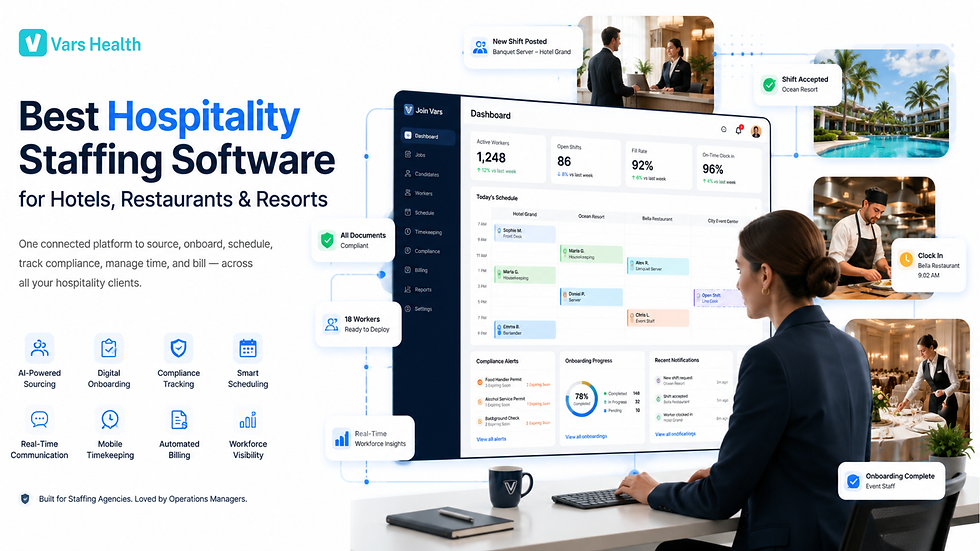
Join Vars is a workforce management software platform built for staffing agencies. See how it serves the full range of staffing industries it supports. Its Staffing and Scheduling module is designed to replace the disconnected, coordinator-heavy approach most agencies are still using.
Here’s how it maps to real agency operations:
Calendar Manager
Coordinators get a single dashboard to track all job requests, monitor their status in real time, and filter by client, shift type, date range, or worker. No more switching tabs. No more hunting through emails to find out if a shift was confirmed.
Operational benefit: When a client calls about a shift, your coordinator can answer in seconds, not after checking three different tools.
Smart Matching Engine
When a job request comes in, the system automatically surfaces the most relevant candidates through AI candidate matching, drawing on client requirements and detailed candidate profiles. It accounts for credentials, location, availability, and shift history not just whoever happens to be at the top of a spreadsheet.
Pro Tip for Staffing Agencies The matching engine only works as well as your candidate profiles. Before rollout, invest time cleaning up worker credentials, availability windows, and skill tags in your system. Garbage in, garbage out still applies. |
Broadcast System
Once candidates are identified, the system sends simultaneous job alerts via email, SMS, or push notification. Workers can accept or decline directly from their device, whether that is the agency’s white-label mobile app or a standard browser. The first confirmed acceptance locks the shift. This is what collapses a 45-minute phone tree into a 4-minute automated fill.
Time and Location Tracking
Workers clock in through the app. The system logs hours with precision, tracks overtime, and uses geo-verification to confirm on-site attendance data that flows directly into the timekeeping and billing workflow. If a worker clocks in from three miles away, your coordinator knows immediately, not at the end of the pay period when the dispute is harder to resolve.
Integrated Chat
Workers and clients can communicate directly through the platform’s built-in communication module. Every message is logged and visible to your team. No more relying on personal cell phones for shift coordination, which means no more lost messages and no more accountability gaps.
Shift Reports
Workers complete post-shift reports from their device using custom templates your agency sets up. New workers deploying to the same site can review past reports before their shift. This is particularly valuable in healthcare and industrial settings where site-specific context matters.
How Does AI Staffing Scheduling Software Reduce Time-to-Fill?
Time-to-fill is the metric most agency owners care about most. Here is where manual processes break down, a pattern also documented in research on how AI-powered workflow automation is transforming staffing efficiency, and where automated scheduling recovers the time:
Workflow Step | Manual Process | With Join Vars |
Receive job request | Email or phone, logged manually | Auto-captured in Calendar Manager |
Identify candidates | Coordinator searches spreadsheets | Smart Matching Engine surfaces qualified workers instantly |
Notify candidates | Phone calls or texts one by one | Broadcast to all qualified workers simultaneously |
Confirm placement | The coordinator follows up individually | Worker accepts via app; shift locked automatically |
Track attendance | Trust-based; verified after the fact | Geo-verification at clock-in |
Export to payroll | Manual re-entry the top cause of errors covered in guides to automated payroll software | Verified hours are exported directly |
Manual payroll re-entry is the most common billing error in agencies. For a deeper look, see this guide on automated payroll software for staffing agencies.
Common Operational Mistake Agencies often implement scheduling software but keep their old phone-call confirmation process running in parallel. This creates duplicate records and negates the speed gains. Commit to one system, or the benefit is lost. |
Is Staffing Scheduling Software Worth It for Mid-Size and Growing Agencies?
Agency owners at the 50 to 300 active worker range ask this question most often. The honest answer: it depends on what is breaking. If your fill times are slow because coordinators are overwhelmed, a scheduling platform directly solves that, as explored in detail in this overview of staffing software for economic uncertainty.
If fills are slow because your candidate pool is too thin, software will expose that problem faster, but it will not fix your sourcing pipeline on its own.
Where the ROI is clear:
Your coordinators spend more than 3 hours per day on shift logistics
You are managing 5+ clients with recurring shift patterns
You have experienced at least one billing dispute tied to unverified hours
Your payroll team re-enters shift data by hand
Clients have asked for real-time updates on worker attendance
Where process change is also required:
Candidate profiles are incomplete or out of date
Credentialing records are not centralized, something the employee attestation and credentialing module is built to address
Coordinators are not yet trained to trust automated matching over manual preference
Key Takeaway for Operations Leaders Scheduling software gives your team leverage. But leverage only works when the underlying process is defined. Map your current shift workflow before implementation. Know your handoffs. The tool will make what you have faster, not fix what is broken underneath. |
What Should Agency Owners Look for in Staffing Scheduling Software?
Not all scheduling tools are built for staffing agencies. Here is what to look for, and how it fits inside an all-in-one staffing software stack:
Candidate matching based on credentials and availability: not just name and phone number.
Multi-channel broadcast: email, SMS, and push notification simultaneously, not sequentially.
Geo-verified clock-in: eliminates time theft disputes without confrontational conversations.
Payroll integration: verified hours should flow directly into staffing billing software without manual re-entry.
Real-time visibility: coordinators and owners should see shift status without asking anyone.
Post-shift reporting: customizable templates that travel with the shift history.
Client communication log: every message between worker and client should be visible to your team.
A tool that has broadcast but no payroll integration will still leave you with a data entry problem at the end of every pay period. Evaluate the full workflow, not just the feature list.
Frequently Asked Questions
How long does it take to implement staffing scheduling software?
For most mid-size agencies, a focused implementation takes 4 to 8 weeks, a timeline similar to what agencies experience when undertaking digital transformation in their overall staffing operations. The largest variable is how clean your existing candidate data is. Agencies with organized credentials and availability records get up faster than those migrating from fragmented spreadsheets.
Can small staffing agencies (under 50 workers) benefit from scheduling software?
Yes, but the return is different. At a smaller scale, the biggest gain is process consistency rather than raw speed. You establish a repeatable, documented workflow early, which means when you grow to 200 workers, you are not rebuilding your operations from scratch.
What is the difference between a staffing scheduling tool and a basic calendar app?
A calendar app tracks when things are happening. A staffing scheduling platform manages the full workflow: matching candidates to jobs, broadcasting openings, confirming placements, verifying attendance, logging communication, and exporting to payroll. The calendar is one view inside a much larger operational system.
Will scheduling software work if our coordinators resist changing their process?
Adoption is the single biggest implementation risk. The best approach: involve coordinators in the configuration, not just the training. When they help define shift templates and matching criteria, they trust the output. When the tool is handed to them as a finished product, pushback is common.
How does geo-verification actually work in practice?
Workers clock in through the mobile app. The system captures their GPS location at that moment and compares it against the job site address. If the location is outside an acceptable radius, the coordinator is flagged. Workers do not always know this is happening, which makes the data more reliable than an honor system.
Does Join Vars’ scheduling module connect to other parts of the platform?
Yes. The staffing and scheduling module sits inside a broader platform that includes an AI-powered applicant tracking system, candidate onboarding, timekeeping, payroll and billing, a dedicated compliance module, and communication tools, all connected in one platform. Shift data flows between modules without manual handoffs, which is where the real operational efficiency lives.
The Practical Next Step for Staffing Agency Owners
Scheduling is the operational heartbeat of a staffing agency. When it works well, clients are happy, workers show up reliably, and coordinators can focus on relationships instead of logistics. When it breaks, everything downstream breaks with it.
AI staffing scheduling software does not eliminate the need for experienced coordinators. What it does is remove the repetitive, error-prone tasks that consume their time and replace them with a reliable system that scales as your agency grows.
The most useful thing you can do today is not evaluate software. It is to map your current shift workflow from request to payroll export and identify exactly where time is being lost. Once you know where the bottleneck is, you will know exactly which tool capabilities matter most for your agency.
If you are ready to see how a modern scheduling module fits into your specific operation, book a free demo with Join Vars to walk through the workflow with your own use cases. No generic slides, just a direct look at how the tools work in practice.


Comments