
Workforce Management Software for Staffing Agencies: Trends, Tools & Best Practices
- Oct 23, 2025
- 6 min read

The staffing world is undergoing a major technological shift, and agencies that embrace it are seeing real results. Today, workforce management software for staffing agencies isn’t just a convenience; it’s the backbone of smarter operations, faster placements, and more satisfied clients. From AI-powered recruiting to automated compliance tracking and integrated payroll solutions, modern staffing platforms are transforming the way agencies operate.
In the past, many agencies relied on disconnected tools for candidate tracking, scheduling, billing, and compliance, creating inefficiencies and leaving room for errors. Now, with a unified staffing agency workforce management software, every step of the process, from hiring to invoicing, can happen in one seamless digital platform.
This isn’t just about saving time. It’s about accuracy, scalability, and data-driven decisions that help agencies stay ahead in a competitive market. So, if you’re wondering how workforce management software can truly transform your staffing agency, the answer is clear: adopting the right technology is no longer optional; it’s essential for growth, efficiency, and long-term success.
For years, staffing agencies operated with mostly manual or semi-digital processes, making day-to-day operations time-consuming and prone to errors:
Recruitment often meant managing endless phone calls, scouring multiple job boards, and sifting through stacks of paper resumes.
Time tracking was a headache, relying on paper timesheets or basic spreadsheets that were easy to misplace or miscalculate.
Payroll involved tedious data entry, often requiring teams to manually input hours into separate accounting or payroll systems.
Compliance depended on static documents and manual checks, which made staying up-to-date with ever-changing labor laws a constant challenge.
A 2019 Deloitte survey found that nearly 47% of staffing firms were still juggling three or more disconnected systems just to keep their operations running. This fragmentation led to several persistent problems:
Slower hiring cycles made it difficult to meet client demands quickly
Higher administrative workload, taking staff away from strategic activities
Increased errors in payroll and billing that could impact both employees and clients
Difficulty maintaining compliance across multiple states or jurisdictions
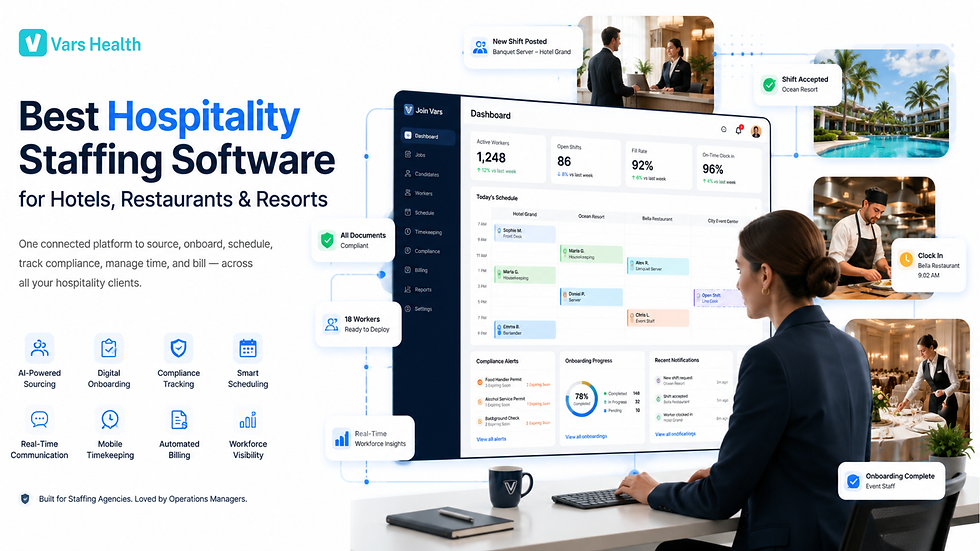
Over the last decade, the staffing technology landscape has evolved dramatically. Cloud-based platforms and API-driven integrations have made it possible to bring every aspect of staffing into a single, unified system. Today’s workforce management software for staffing agencies allows firms to manage recruitment, scheduling, time tracking, payroll, billing, and compliance all from one intuitive dashboard.
By adopting modern staffing agency workforce management software, agencies can:
Streamline workflows and reduce administrative overhead
Minimize errors in payroll and billing
Ensure consistent compliance across all placements
Gain real-time insights to make smarter, data-driven decisions
Free up recruiters and operations staff to focus on building relationships and growing the business
In short, moving from fragmented tools to a unified staffing workforce management platform isn’t just a technology upgrade; it’s a strategic move that empowers agencies to operate faster, smarter, and more efficiently while giving them the flexibility to scale as the market demands.
Five Key Trends Driving Workforce Management Software for Staffing Agencies
1. AI-Powered Recruitment
Artificial intelligence is completely transforming the way staffing agencies find, evaluate, and place talent. Modern workforce management software for staffing agencies leverages AI to do the heavy lifting, automating repetitive tasks and surfacing the best candidates faster than ever.
Analyze and rank candidates by skills, experience, and certifications
Predict availability based on historical data and trends
Automatically shortlist the best-fit candidates for a role
Beyond saving time, AI improves the quality of placements. Recruiters no longer have to sift through hundreds of resumes manually, they can focus on building relationships, coaching candidates, and understanding client needs.
Example: A mid-sized staffing agency integrated AI-driven resume parsing and saw a 40% reduction in time-to-fill, while simultaneously increasing the success rate of placements. With AI handling candidate screening, recruiters can handle more openings without sacrificing quality, giving the agency a measurable competitive edge.
2. Automated Time Tracking, Billing, and Payroll
Manual timesheets and spreadsheets are not only slow but also prone to mistakes and fraud. Modern staffing platforms bring accuracy, transparency, and speed to these processes.
Mobile and biometric clock-ins to reduce errors and fraud
Geofencing and location validation for on-site compliance
Direct integration with payroll and billing systems, eliminating duplicate work
With automated workflows, agencies can instantly see which hours have been worked, process payroll correctly, and bill clients without delay. This is especially critical for agencies handling complex pay rules across multiple clients and locations.
Industry Insight: According to the American Payroll Association, automation can reduce payroll processing costs by up to 80%. Beyond cost savings, it also frees up operations teams to focus on strategic tasks like workforce planning and client engagement.
3. Compliance Built Right Into the Platform
Keeping up with labor laws and regulations can be a nightmare for staffing agencies, especially those operating across multiple states or industries. A unified staffing agency workforce management software makes compliance automatic, reducing legal and financial risk.
Receive alerts when shifts or assignments break labor laws
Automatically apply wage laws across multiple states or industries
Maintain digital audit trails for client reporting or government inspections
With compliance integrated directly into the software, agencies can confidently scale operations without fear of violations. It also allows HR teams to spend less time on paperwork and more time on strategy, such as identifying skill gaps or optimizing workforce deployment.
4. Scalability for On-Demand Staffing
Staffing demands can surge without warning, think seasonal hiring spikes, sudden healthcare needs, or large corporate projects. Cloud-based staffing workforce management platforms allow agencies to scale seamlessly.
Instantly onboard dozens of workers at once
Expand into new locations without buying additional software licenses
Monitor distributed teams in real time
Example: A logistics staffing company scaled from 150 to 500 employees in a single month during peak season. The platform handled everything from onboarding to payroll and scheduling, allowing the agency to meet client demands without adding back-office staff.
Scalability also means agencies can experiment with new business lines or markets without being slowed down by manual processes or rigid software. This flexibility can be a key differentiator in competitive markets.
5. Mobile-First Workforce Engagement
Today’s workforce expects tools that are mobile-accessible and easy to use. Agencies that adopt mobile-first platforms see higher retention, faster response times, and more satisfied workers.
Immediate shift acceptance or swaps via mobile apps
Upload compliance documents on-the-go
Push notifications for urgent job postings
Mobile access gives workers autonomy and flexibility, which improves engagement. Recruiters also benefit from faster communication and real-time updates, making scheduling and staffing more efficient. According to Staffing Industry Analysts, agencies offering robust mobile portals experienced 25% higher worker retention, proving that digital engagement directly impacts bottom-line results.
Actionable Best Practices for Staffing Agencies Using Workforce Management Software
Choose scalable, API-friendly platforms – Ensure flexibility for future growth.
Prioritize compliance first – Let the software automatically apply correct wage and labor rules.
Track key metrics – Measure fill rates, payroll errors, and compliance incidents to assess ROI.
Invest in thorough training – Software is only effective when fully adopted by your team.
The Future of Workforce Management Software
The next generation of staffing workforce management platforms will be more intelligent, predictive, and secure:
Predictive analytics to forecast demand by region and industry
Skills-based scheduling for precise shift assignments
Advanced biometric security for sensitive placements
Blockchain-based payroll and compliance tracking for full transparency
Agencies embracing these innovations will enjoy faster response times, lower compliance risks, and higher margins, building a truly competitive, future-ready operation.
Final Takeaways
Modern staffing agencies can no longer rely on manual processes or disconnected tools. Today, workforce management software for staffing agencies is the engine that drives efficiency, accuracy, and growth. Platforms like Join VARS combine recruitment, scheduling, payroll, and compliance into a single, seamless experience, giving agencies the freedom to focus on what truly matters, placing the right talent in the right roles.
By adopting a staffing agency workforce management software, agencies can reduce errors, save time, and respond faster to client demands. Automation and AI don’t just streamline operations; they empower recruiters and managers to make smarter, data-driven decisions while improving worker engagement and retention.
The real question isn’t whether to implement digital solutions; it’s how quickly your agency can leverage them to stay competitive, scale operations, and exceed client expectations. Agencies that move fast today will be the market leaders tomorrow.
See how Join VARS can transform your staffing agency with AI-powered recruiting, automated time tracking, and integrated payroll and compliance. Book a Free Demo Today and discover a smarter, faster way to manage your workforce.


Comments