
Best Staffing Agency Software for Scaling Your Recruitment Business
- Apr 20
- 12 min read
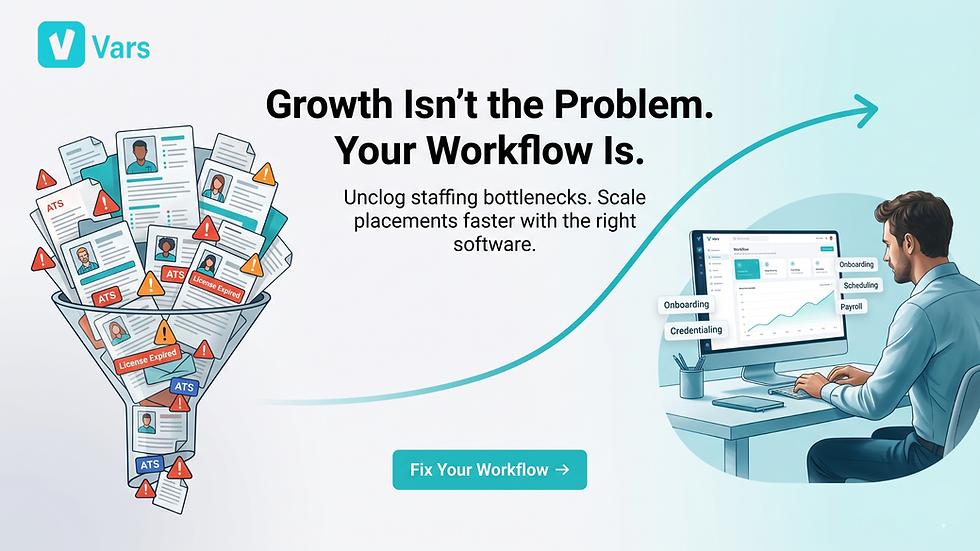
If your staffing agency is still juggling spreadsheets, disconnected ATS tools, and manual credentialing checklists, your operations are your biggest growth blocker. The right staffing agency software does not just automate tasks. It connects every part of your workflow: recruiting, onboarding, credentialing, scheduling, payroll, and compliance, so your team can place more candidates without adding more headcount.
This guide is written for staffing leaders at the decision stage, operations managers, agency owners, and compliance leads who are ready to evaluate platforms seriously. We will walk through what actually matters, where most agencies get stuck, and how a connected software platform changes the daily reality of running a staffing agency at scale.
Why Most Staffing Agencies Hit a Growth Ceiling Without the Right Software
Growth in staffing is not just a recruiting problem. It is an operational problem. When you are placing 20 workers a week, a combination of email threads, shared spreadsheets, and manual follow-ups can barely work. At 80 placements a week, those same systems collapse.
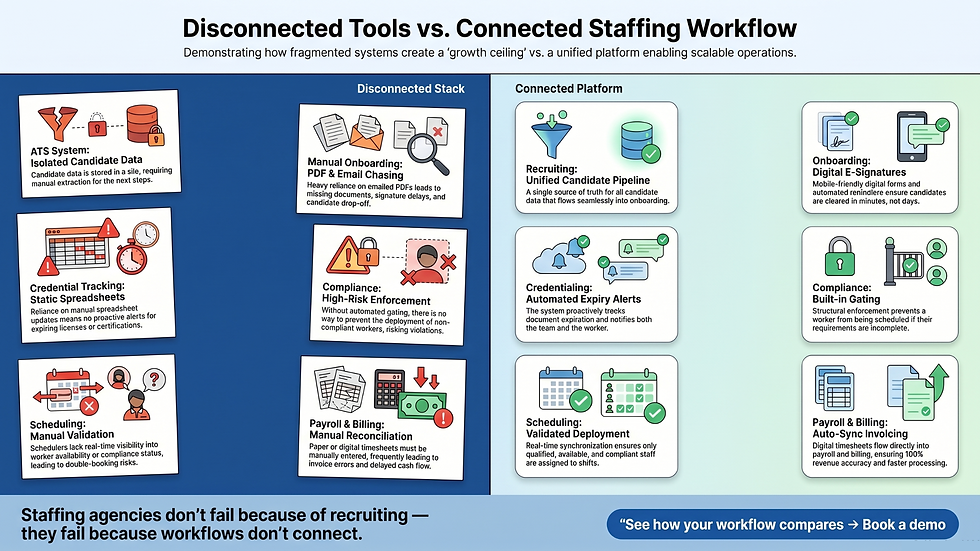
The most common breaking points we see in growing staffing agencies:
Onboarding delays: Candidates are hired, but paperwork stalls their start date. Documents are missing. Signatures are chased over email. The hiring manager is calling your team daily.
Credentialing gaps: Compliance documents expire quietly. No one flags it until a client raises an issue or a worker is pulled off an assignment.
Recruiter overload: Your recruiters are re-entering data across three platforms. Time that should go to sourcing goes to admin.
Payroll and billing errors: Timesheets come in manually. Invoices go out late. Disputes with clients take weeks to resolve.
No operational visibility: Leadership cannot see placement rates, pipeline health, or compliance status without building a manual report.
▸ What Usually Breaks at Scale It is rarely the recruiting team that breaks first. It is the onboarding and credentialing workflow that cannot absorb the volume. Agencies that scale past 100 weekly placements without structured software almost always experience a compliance incident or a candidate drop-off crisis within 12 months. |
What Does a Purpose-Built Staffing Agency Software Platform Actually Cover?
The term 'staffing software' gets used loosely. Some vendors mean ATS only. Others mean scheduling only. When evaluating platforms for a growing agency, you need to understand whether the tool covers the full operational lifecycle or just one slice of it.
A complete staffing agency software platform should cover these core functions:
Workflow Area | What It Covers | Why It Matters |
Applicant Tracking | Job postings, pipeline management, and candidate stages | Recruiter efficiency, time-to-fill |
Candidate Onboarding | Digital document collection, e-signatures, and orientation tasks | Faster start dates, fewer no-shows |
Credentialing | License tracking, expiry alerts, document verification | Compliance readiness, client trust |
Compliance Management | Policy tracking, audit trails, regulation-based checklists | Reduces risk, supports audits |
Scheduling & Staffing | Shift assignment, worker availability, deployment tracking | Client fulfillment, workforce utilization |
Digital timesheets, client invoicing, payroll data sync | Revenue accuracy, faster cash flow | |
Payroll Processing | Pay calculations, deductions, and direct deposit | Worker satisfaction, back-office efficiency |
Communication Tools | Automated messaging, candidate notifications, team alerts | Reduces manual follow-up time |
Vendor Management | Subcontractor tracking, client portal access, and order management | Scales multi-client operations |
White Label Mobile App | Branded app for workers and clients | Professional experience, higher engagement |
AI Candidate Matching | Skill-based matching across the active candidate pool | Faster fills, better placement quality |
Reporting & Analytics | Real-time dashboards, recruiter performance, and compliance status | Data-driven decisions for leadership |
▸ Key Takeaway for Operations Leaders Most agencies are not missing one tool; they are missing a connected system. A recruiter using one ATS, a compliance team tracking credentials in a spreadsheet, and a payroll team working in a separate platform creates data silos that directly cause onboarding delays and billing errors. |
How Do Healthcare Staffing Agencies Manage Onboarding at Scale Without Losing Candidates?
Onboarding is where most staffing agencies lose placed candidates before they even start. In healthcare staffing, especially, the credentialing and documentation requirements are extensive, and slow, manual processes drive candidates to accept competing offers while waiting.
What a broken onboarding process looks like in practice:
A travel nurse accepts an offer on Tuesday. Onboarding paperwork is emailed manually.
The candidate fills in a PDF, scans it, and emails it back sometimes days later.
The credentialing team manually reviews, flags missing items, and emails again.
The recruiter follows up by phone. Repeat three to four cycles before the candidate is cleared.
The start date slips. The client escalates. The candidate takes a different placement.
What structured onboarding software changes:
Digital document packets are sent automatically when a candidate accepts an offer. No email attachments.
E-signature workflows allow candidates to complete required forms from their phone in minutes.
Automated reminders follow up on missing documents without recruiter involvement.
Credential tracking flags expiring licenses before they become placement blockers.
Onboarding dashboards show operations managers exactly where each candidate is stuck and why.
Join Vars is built with this exact workflow in mind. The candidate onboarding module connects directly to credentialing, compliance, and scheduling, so the moment a candidate is cleared, they move into the deployment pipeline without any manual handoff. For healthcare staffing agencies managing high-volume travel nurse or allied health placements, this connection between onboarding and deployment readiness is where the platform delivers the most immediate operational value.
▸ Common Operational Mistake Agencies often invest in a better ATS to fix onboarding delays but the ATS only covers the recruiting phase. Onboarding delays happen after the offer is accepted. That is a different workflow that requires a different set of tools. See how agencies are solving this with digital employee onboarding software. |
How Can Staffing Agencies Track Compliance Without Manual Spreadsheets?
Compliance tracking in spreadsheets is not just inefficient, it is a liability. When you are managing certifications, background checks, health screenings, and state-specific licensing requirements across hundreds of active workers, a spreadsheet will always have gaps.
The compliance problems that come up repeatedly in mid-size staffing agencies:
Certifications expire because no one is assigned to monitor them proactively.
New state licensing requirements are missed because policy updates are not tracked in the system.
Audit requests from clients or regulators require manual document assembly, which takes days.
Workers are deployed with lapsed credentials because the credential check is not automated at the scheduling stage.
What compliance management software actually fixes:
Automated expiry alerts notify the compliance team and optionally the worker before a credential lapses.
Requirement checklists tied to job type and state ensure every worker meets the correct standard before assignment.
Audit-ready document storage keeps signed forms, certifications, and screening results organized and accessible.
Deployment gating prevents scheduling a worker whose credentials have not been cleared.
In the Join Vars platform, compliance management is not a separate module that runs independently. It is woven into the onboarding, credentialing, and scheduling workflow. A worker cannot move to the scheduled stage if compliance requirements are incomplete. That structural gating is what prevents the most common compliance failures in staffing operations.
▸ Pro Tip for Staffing Agencies Before investing in a compliance module, map your current credential expiry process end-to-end. Identify whether the breakdown is in tracking (you do not know when things expire), notification (no one is alerted in time), or enforcement (credentials lapse but deployment still happens). Each requires a different fix. For a deeper look, read our guide on workforce compliance software for staffing agencies. |
What Is the Role of AI Technology in Modern Recruitment Software for Staffing Agencies?
The staffing industry has been cautious about AI and reasonably so. Overpromised tools that do not integrate into actual agency workflows have led to skepticism. But there are specific, narrow applications where AI genuinely reduces recruiter workload without introducing risk.
Where AI delivers real value in staffing operations:
AI Candidate Matching: When your database has thousands of candidates, manually reviewing profiles for each open order wastes recruiter time. AI matching surfaces the most qualified candidates based on skills, certifications, availability, and location in seconds.
AI Voice Recruiter: Initial candidate outreach and screening calls at high volume are time-consuming. An AI voice recruiter handles the first contact, collects availability and basic qualification data, and flags interested candidates for human follow-up.
Vars AI Now: An operational assistant that helps recruiters and managers navigate their workflows, pull reports, and get answers to operational questions without switching between screens.
These are not replacement tools for your recruiters. They are tools that remove the repeatable, low-judgment tasks so your team can focus on the conversations that require human relationship skills working with hiring managers, managing candidate experience, and solving placement problems. For a practical evaluation guide, see our post on AI tools for staffing agencies.
▸ Key Takeaway for Operations Leaders AI in staffing software works best when it is embedded in a workflow, not bolted on as a separate feature. If your team has to switch contexts to use it, adoption will be low. Look for platforms where AI matching and communication tools operate within the same pipeline your recruiters are already working in. |
Is a White Label Mobile App Worth It for a Mid-Size Staffing Agency?
A branded staffing mobile app for your workers is not a vanity feature. It is an operational tool that changes how your workforce communicates, submits timesheets, views schedules, and manages their own compliance documents.
What a white-label mobile app actually enables:
Workers receive shift notifications and can confirm or decline directly in the app.
Digital timesheets submitted from mobile reduce manual entry and speed up billing cycles.
Onboarding tasks and document uploads are completed by the candidate on their phone, not in your office.
Push notifications for credential expiry reminders, reducing your team's manual follow-up load.
Workers access their placement history, contact information, and pay stubs without calling your team.
For staffing agencies in the decision stage, the question is usually whether the investment justifies the operational return. The clearest case is in healthcare staffing, where workers are mobile, remote, and managing their own compliance requirements. A branded app that handles the communication and documentation loop reduces your team's admin burden while improving the worker experience, which matters for retention in a competitive talent market.
How Should Staffing Agencies Evaluate Software Platforms Before Making a Decision?
Buying staffing software is a multi-year operational commitment. The wrong platform does not just cost money; it costs time during implementation, disrupts workflows, and can slow your growth during the transition period. Agencies navigating this shift can benefit from understanding what digital transformation in staffing agencies actually looks like in practice.
A practical evaluation framework for staffing agency software:
Map your current workflow first. Identify where your biggest delays and errors occur before evaluating any tool. The platform should solve real problems, not create new ones.
Assess coverage vs. connection. A platform that covers more of your workflow with native integrations is more valuable than a best-in-class point solution that requires custom integration work.
Ask about onboarding and implementation timelines. A platform that takes six months to implement will slow your operations during your highest-growth period.
Test compliance configuration for your states and roles. Generic compliance modules will not cover the specific credentialing requirements for your industry and geography.
Evaluate reporting depth. If a platform cannot show you recruiter productivity, time-to-fill, and compliance status in a single dashboard, it will not give you the operational visibility you need to scale.
Ask what happens when your volume doubles. Platforms that work well at 50 placements per week often show cracks at 200. Get reference customers at a similar scale.
▸ Common Operational Mistake Many agencies choose software based on the demo, not the implementation. A polished interface can mask a complicated setup process or a rigid configuration that does not adapt to your specific agency workflows. Always ask to speak with operations teams at agencies already using the platform at your target scale. |
Staffing Software Platform vs. Point Solutions: What Actually Works for Growing Agencies?
Many agencies arrive at a crossroads: continue building a stack of specialized tools for each function, or move to a connected staffing platform that handles the full workflow. Both approaches have tradeoffs.
Criteria | Separate Point Solutions | Connected Platform (e.g., Join Vars) |
Setup time | Each tool requires separate setup | Single implementation across all modules |
Data consistency | Manual syncing required between tools | Shared data layer no re-entry |
Onboarding workflow | Multiple logins and handoffs | Single pipeline from offer to deployment |
Compliance enforcement | Manual checking across systems | Automated gating at each workflow stage |
Recruiter experience | Context-switching between platforms | Single workspace for all workflow stages |
Reporting | Aggregation requires manual work | Real-time cross-functional dashboards |
Cost at scale | Licensing multiplies with headcount | Consolidated pricing as volume grows |
AI integration | Often not available or poorly integrated | Embedded in core workflow modules |
Frequently Asked Questions
These are the questions staffing operations teams ask most often when evaluating workforce management software. They are written to reflect the way recruiting leaders and compliance managers actually search for answers, specific, operational, and decision-oriented.
How long does it take to implement staffing agency software for a mid-size operation?
Implementation timelines vary based on the size of your agency, the number of modules being configured, and how complex your existing workflows are. A focused implementation covering ATS, onboarding, and basic compliance can be operational in four to eight weeks. Full platform deployment, including payroll integration, VMS setup, and custom credentialing requirements, typically takes two to four months. The agencies that implement the fastest are those that have already mapped their current workflows and assigned a clear internal owner to the project.
What staffing agency software features actually matter for healthcare credentialing compliance?
For healthcare staffing software, the most critical features are: automated credential expiry tracking with configurable alert timelines, role-based and state-specific requirement checklists, audit-ready document storage, and deployment gating that prevents scheduling a worker with incomplete or expired credentials. A generic compliance module built for light industrial or clerical staffing will not cover the nuance of travel nurse or allied health credentialing. Verify that the platform supports the specific license types and background screening requirements for your clinical roles before committing.
Can small staffing agencies with under 50 placements per week actually benefit from staffing software?
Yes, but the ROI calculation is different. At lower volume, the primary benefit is not efficiency at scale; it is building the operational infrastructure that allows you to grow without breaking. Agencies that implement connected software early establish clean data practices, automated compliance tracking, and structured onboarding workflows that become increasingly valuable as volume grows. The common mistake is waiting until the operation is already stressed to implement software; by that point, the implementation competes with day-to-day urgency.
How does staffing agency software handle payroll and billing for contract and temp placements?
In a well-built platform, payroll and billing are directly connected to timekeeping and scheduling data. Workers submit digital timesheets from the mobile app or web portal. Approved hours flow automatically into pay calculations and client invoice generation. This eliminates the manual reconciliation step that causes most billing delays and payroll errors in staffing operations. For agencies managing multiple bill rates, overtime rules, and client-specific billing arrangements, verify that the platform's billing configuration is flexible enough to handle your specific contract structures before implementation.
What is the difference between a Vendor Management System (VMS) and a staffing agency software platform?
A Vendor Management System is used by enterprise clients, typically large hospitals or corporations, to manage their relationships with multiple staffing agencies. It is a procurement tool on the client side. A staffing agency software platform is the operational system on the agency side. Some platforms include a VMS module that allows the agency to manage its own direct clients, track order fulfillment, and provide client-facing portals. If you are a staffing agency that wants to offer a managed services or VMS-style experience to your clients, look for a platform that includes this module natively.
How do AI candidate matching tools in staffing software actually work in practice?
AI candidate matching works by comparing the requirements of an open order job type, required certifications, location, and availability window against your existing candidate database. The system scores and ranks candidates based on how well their profiles match the requirements, surfacing the top candidates for recruiter review. The quality of the matching depends entirely on the completeness of your candidate data. Agencies with clean, well-maintained candidate profiles will see the most immediate benefit. Agencies with fragmented or outdated data will need to invest in a data cleanup phase before AI matching delivers reliable results.
Does staffing software work for agencies placing software engineers or IT professionals?
Yes. While healthcare staffing has the most complex credentialing requirements, software engineer and IT staffing agencies have their own operational needs: skill-based candidate matching, client portal access for job order management, contract tracking, and timekeeping that handles flexible and remote work arrangements. The core workflow, sourcing, ATS, onboarding, contracts, timekeeping, and billing apply across all staffing verticals. The configuration and specific compliance requirements differ by industry, but the operational platform is the same.
What should a staffing agency prioritize first when transitioning from spreadsheets to software?
Start with onboarding and credentialing. These are the workflows where manual processes cause the most immediate candidate loss and compliance risk. Getting digital onboarding and automated credential tracking in place first gives your operations team immediate relief and produces visible results, shorter time-to-deploy, and fewer compliance incidents that build internal confidence in the platform. ATS migration and payroll integration are higher-complexity workstreams. They matter for scale, but they are not where you will see the fastest return in the first 60 to 90 days.
Where to Start If You Are Ready to Scale Your Staffing Operation
If you have read this far, you are likely past the awareness stage. You know your operation has gaps. The question is what to prioritize and where to begin.
The most practical next step is a workflow audit. Before evaluating any platform, map your current onboarding process from offer acceptance to the first day of work. Count the manual steps. Identify every point where a candidate could fall through without someone following up. That map will tell you where software will have the most immediate impact.
Join Vars is built for staffing agencies that are serious about operational infrastructure and want to grow beyond what manual processes can support. The platform covers the full operational lifecycle: ATS, onboarding, credentialing, compliance, scheduling, timekeeping, payroll, and billing, connected in a single system, not bolted together from separate tools.
If your agency is ready to move from evaluation to implementation, the most useful conversation is a workflow review, not a product demo. Understanding your specific operational structure is what determines which modules to configure first and what implementation timeline makes sense for your team.
Visit joinvars.com to learn more about how agencies are using the platform to scale their operations without scaling their admin overhead.
joinvars.com | Workforce Management Software for Staffing Agencies | Built for Scale


Comments