If you work at a staffing agency or manage vendors for one, you’ve likely heard the term VMS thrown around. But what is a VMS in staffing, exactly, and does your agency actually need one?
A Vendor Management System (VMS) in staffing is a software platform that helps organizations centralize how they source, manage, engage, and pay contingent workers and the staffing vendors who supply them. In short, it sits between the employer (the buyer of labor) and the staffing agencies (the suppliers of labor) and controls the entire relationship. Join Vars includes a purpose-built vendor management system for staffing agencies designed to sit on the agency side of this relationship.
This guide breaks down how VMS platforms actually work in day-to-day staffing operations, where they help, where they fall short, and how agencies can position themselves to win and retain VMS-managed accounts. For more on how agencies are using vendor management tools, see the benefits of vendor management software and the best vendor management software for staffing agencies.
How Does a VMS Work in the Staffing Vendor Relationship?
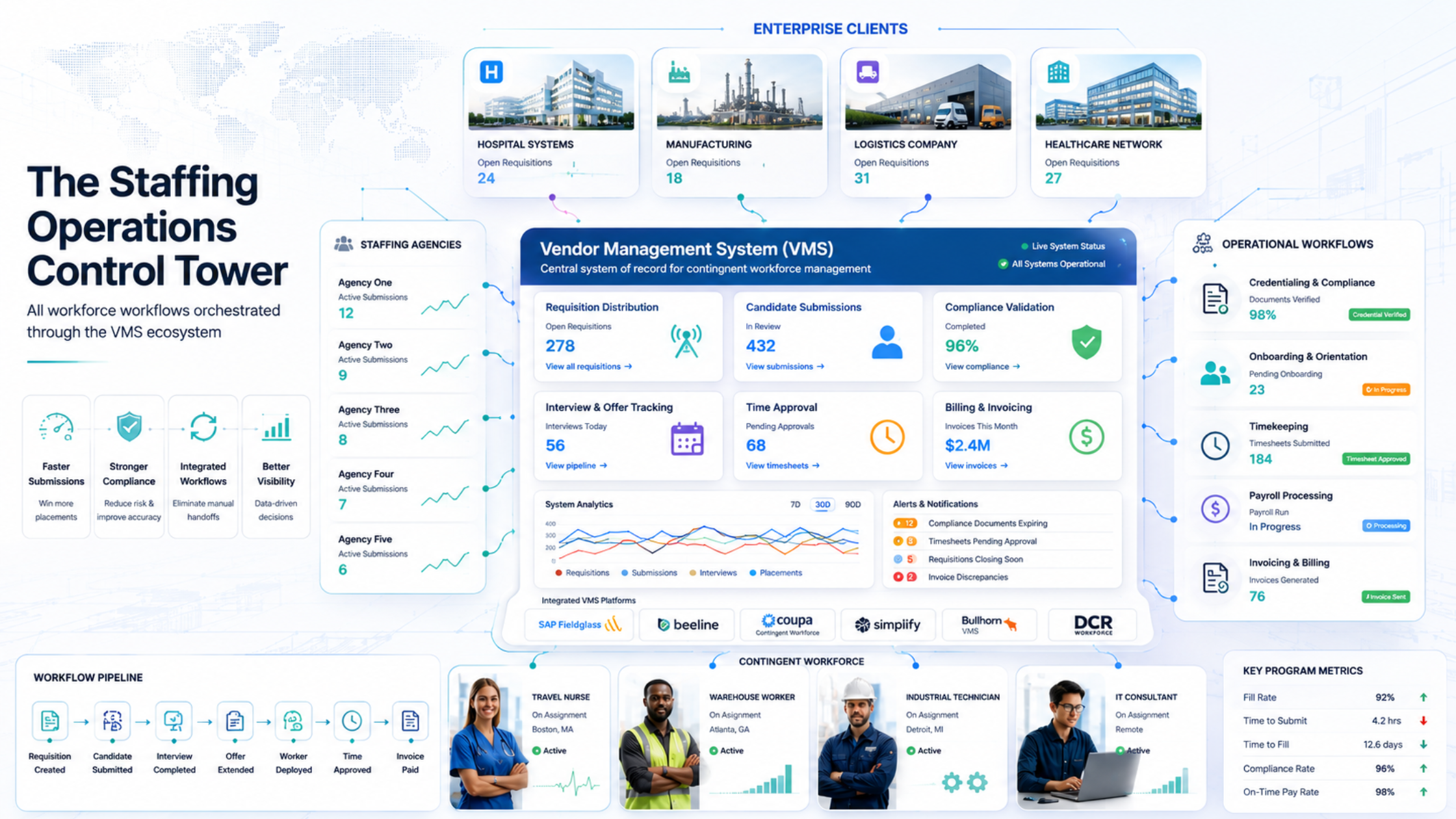
Most agencies encounter a VMS when a large enterprise client a hospital system, a logistics company, or a manufacturer, rolls one out to manage all their staffing suppliers from a single dashboard.
Here’s what that typically looks like in practice:
The client posts an open requisition inside the VMS platform
That requisition is distributed to approved staffing vendors (a “preferred vendor list”)
Each agency submits candidates directly through the VMS
Interview scheduling, offers, onboarding documents, and time approvals all flow through the same platform
Invoicing and payment are triggered by approved timesheets, also inside the VMS
The VMS becomes the system of record for that client relationship. Every submission, every placement, every bill rate, every compliance document, it all lives there.
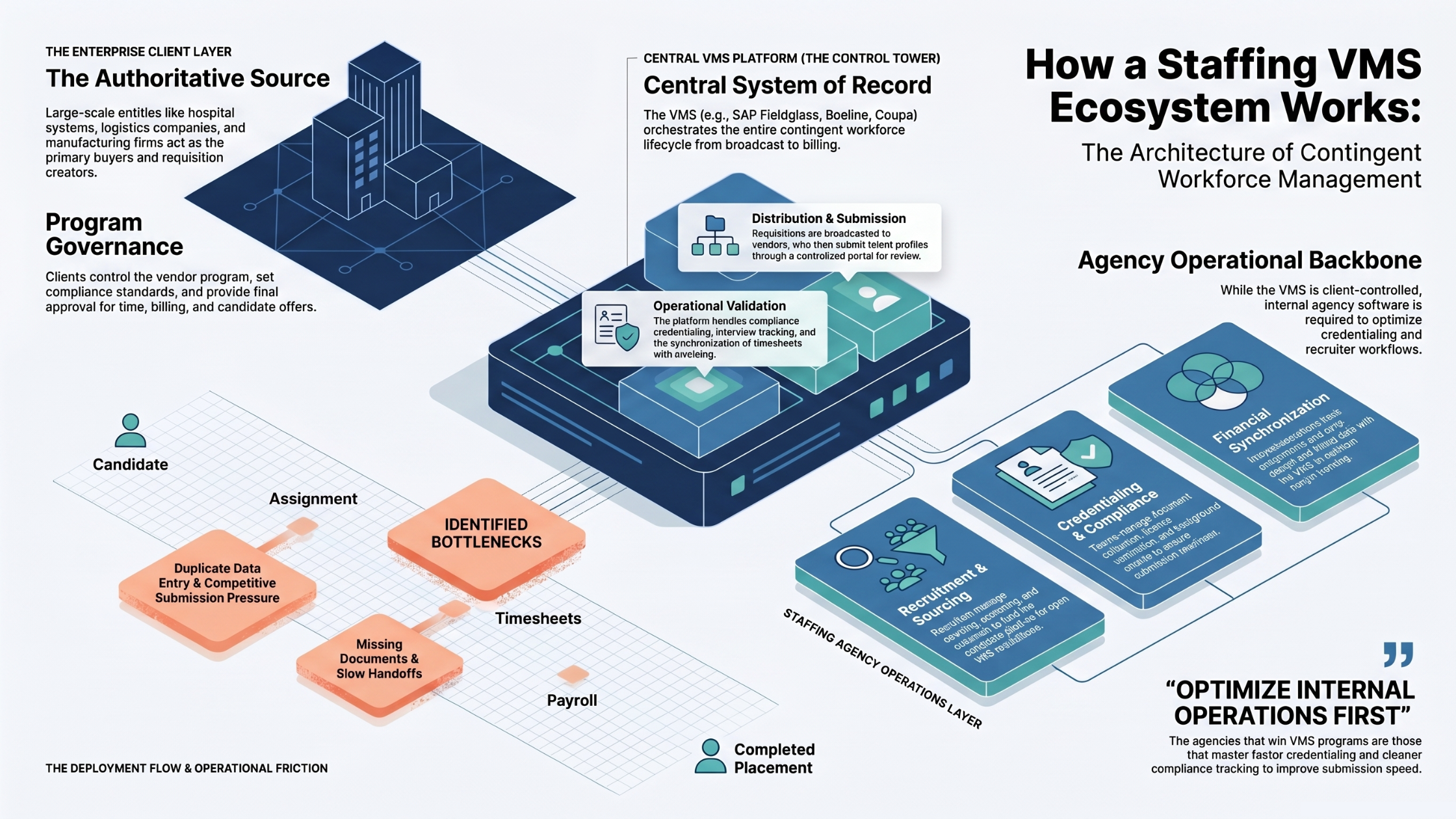
Key takeaway for operations leaders: If a client is running a VMS program, your agency does not interact with that client outside of it. Your ATS, your CRM, and your internal tools must all feed into or sync with that VMS portal.
What Are the Most Common VMS Platforms Used in US Staffing?
See how Vars covers this for your agency
Scheduling, credentialing, and payroll in one platform.
Enterprise clients typically use one of a small number of established VMS platforms. The most widely deployed include:
VMS Platform
Commonly Used In
Fieldglass (SAP)
Large enterprise, healthcare, IT
Beeline
Financial services, healthcare, and manufacturing
Coupa Contingent Workforce
Cross-industry enterprises
Simplify VMS
Mid-market clients
Bullhorn Vendor Management
Staffing-specific programs
DCR Workforce
Healthcare, professional staffing
The challenge for most agencies: each VMS has its own interface, submission format, and compliance requirements. An agency managing five VMS-based clients is essentially managing five different workflows simultaneously.
Why Do Staffing Agencies Struggle With VMS Programs?
This is where most agencies feel the operational pain, not during sales, but after the contract is signed.
Common bottlenecks agencies run into:
Duplicate data entry: Candidate information entered in the agency’s ATS has to be re-entered manually into the VMS portal. This adds hours per week and introduces errors.
Compliance document mismatches: Each VMS program has its own required document checklist. Credentialing requirements for a travel nurse program on Fieldglass will differ from those for a light industrial program on Beeline. Agencies without a centralized compliance tracking module frequently miss documents at submission.
Submission speed: VMS programs are competitive. Most preferred vendor lists have 5–10 agencies competing for the same req. If your internal process takes 48 hours to screen, credential, and submit a candidate, you’re losing placements to agencies that submit in 4–6 hours.
Timesheet and billing disconnects: When time is approved in the VMS, but your internal timekeeping and billing system doesn’t sync, payroll errors and invoicing delays follow quickly.
Visibility gaps: Operations leaders struggle to see which VMS reqs are aging, which candidates are stuck in submission review, and where the workflow is breaking down because the data is split between the VMS and internal tools.
Common operational mistake: Many agencies treat VMS programs as a client management problem rather than an operations problem. The real issue is almost always internal slow credentialing, manual handoffs, and fragmented tooling.
How Can Staffing Agencies Compete Effectively in VMS Programs?
Speed and compliance accuracy are the two levers that determine which agencies win in VMS-managed accounts. Here’s what separates high-performing agencies from the rest:
1. Centralized candidate readiness: Before you can submit a candidate to a VMS, that candidate needs to be credentialed, compliant, and ready. Agencies that pre-credential a bench of available workers using a structured candidate onboarding workflow rather than starting the credentialing process after a request comes in, submit faster and more accurately.
2. Streamlined internal handoffs: In most agencies, a VMS submission involves a recruiter, a credentialing coordinator, and sometimes a compliance manager. If those three handoffs happen over email and Slack, you’re losing hours on every submission. The agencies winning VMS programs have digitized that handoff flow.
3. Document compliance tracking by client: Each VMS client has its own compliance matrix. Agencies that track required documents at the client level using dedicated staffing compliance software, not just at the candidate level, catch gaps before submission, not after rejection.
4. Integrated billing and timesheet sync: When timesheet approvals from the VMS flow directly into your staffing payroll and billing process, you eliminate a major source of payroll errors and invoice disputes. This matters especially in healthcare staffing, where bill rates, overtime rules, and contract terms vary by assignment.
Pro tip for staffing agencies: Map your internal submission workflow before going live on any new VMS program. Identify who owns each step: sourcing, screening, credentialing, document collection, submission, follow-up, and how long each step currently takes. Most agencies find that 60–70% of their submission time is lost in internal handoffs, not in finding candidates.
What Actually Changes Once a VMS Is in Place?
It doesn’t add a new process on top of what you’re already doing. It forces the process you already have to become visible.
Submissions stop living in inboxes. Instead of emailed resumes and Slack pings, everything comes through the VMS in a structured, timestamped queue.
Duplicate confusion drops fast. You can see submission order and ownership instead of guessing who touched a candidate first.
Compliance becomes part of the flow, not a last-minute scramble. Missing documents get flagged early instead of at deployment.
Billing gets less reactive. Approved time flows back into invoicing instead of getting reconciled by hand after the fact.
Common operational mistake: assuming the software fixes a broken process automatically. If your submission and compliance rules aren’t defined before go-live, a VMS just makes the confusion more visible, it doesn’t invent structure for you.
Where Does Staffing Agency Software Fit in a VMS Environment?
This is a question we hear often from operations leaders who are evaluating their internal tooling: “If the client is using a VMS, what do I actually need on my side?”
The honest answer is: the VMS handles the client-facing workflow, but your internal stack handles everything the VMS doesn’t see.
Your agency still needs to:
Source and recruit candidates (the VMS doesn’t do this for you)
Manage the credentialing and document collection process
Track compliance requirements at both the candidate and client levels
Run internal communication between recruiters, coordinators, and compliance teams
Handle payroll for your W-2 workers placed into VMS accounts
Generate agency-side reporting and margin analysis
This is where platforms like Join Vars are built to help. Join Vars is a workforce management software platform for staffing agencies, not a VMS itself, but the internal operational backbone that connects your recruiting, credentialing, compliance, and billing workflows.
In a VMS environment, that means:
Credentialing and onboarding workflows are managed inside Join Vars, so candidates are document-ready before a req ever drops in the VMS
Compliance tracking happens at the client and candidate level, so your team knows exactly what’s missing before submission
Timekeeping and billing can be managed in sync with VMS-approved time, reducing the invoice lag and payroll errors that hurt agency margins on contingent programs
Recruiter and coordinator workflows are organized in one place, so the handoff from sourcing to submission to deployment is visible and trackable not buried in inboxes
What usually breaks at scale: The internal compliance and credentialing workflow. When an agency grows from 3 VMS clients to 12, the manual spreadsheet system for tracking document requirements collapses. The agencies that scale VMS programs successfully are the ones that digitized that process early.
Is a VMS the Same as a Managed Service Provider (MSP)?
No, and this distinction matters operationally.
A VMS is software: a platform that manages vendor relationships and contingent workforce programs.
An MSP (Managed Service Provider) is a company, typically a large staffing firm, that takes over the management of an enterprise client’s entire contingent workforce program, often using a VMS as their operational tool.
If your agency is working inside an MSP program, you may be submitting to a VMS that the MSP controls. In that case, your agency is a sub-vendor, and the MSP sits between you and the end client. The competitive and compliance dynamics are similar, but the relationship structure is different.
Frequently Asked Questions About VMS in Staffing
What does VMS stand for in staffing?
VMS stands for Vendor Management System. In staffing, it refers to software platforms that enterprise organizations use to manage their relationships with multiple staffing vendors, track contingent worker placements, and control timesheet approvals and invoicing.
Do small staffing agencies need to use a VMS?
Small agencies don’t build their own VMS — but they frequently have to submit to a client’s VMS platform to win or manage enterprise accounts. Being operationally ready to work within a VMS (fast credentialing, clean document compliance, integrated billing) matters regardless of agency size.
How long does it take to get approved as a vendor on a VMS?
Vendor onboarding timelines vary by platform and client. Most enterprise VMS programs require proof of insurance, W-9, signed master supplier agreements, and sometimes background screening protocols. Expect 2–6 weeks for full approval on most programs.
What’s the biggest operational mistake agencies make with VMS programs?
Starting the credentialing and document collection process after a req is posted. By the time a candidate is compliant and ready to submit, competing agencies have already filled the position. Pre-credentialing available candidates is the single highest-impact operational shift most agencies can make.
How is a VMS different from an ATS?
An ATS (Applicant Tracking System) is used by your agency to manage your internal recruiting pipeline — sourcing, screening, and tracking candidates. A VMS is the client’s platform for managing vendor submissions and placements. They serve different sides of the same transaction. Many agencies run both: an ATS internally, while submitting to client-owned VMS platforms externally.
Can staffing software help agencies perform better in VMS programs?
Yes, not by replacing the VMS, but by strengthening the internal workflows that feed into it. Faster credentialing, cleaner compliance tracking, and integrated payroll processing all improve submission speed and placement accuracy inside VMS programs. See how staffing agency software supports VMS program performance.
The Bottom Line for Staffing Leaders
A VMS doesn’t replace your agency’s operational infrastructure; it adds a layer of external accountability that exposes every internal gap you already have. Slow credentialing, manual document tracking, disconnected billing- these problems don’t disappear when a client launches a VMS program. They get more visible.
The practical next step is straightforward: map your current submission workflow from req-received to candidate-submitted and time every handoff. Most agencies find the bottleneck within the first hour of that exercise, and it’s almost never a sourcing problem.
If you want to understand how Join Vars supports credentialing, compliance, and operational workflows for staffing agencies managing VMS accounts, visit joinvars.com.
Frequently Asked Questions
What does VMS stand for in staffing?
VMS stands for Vendor Management System, software that lets companies manage multiple staffing agencies, track compliance, and control contingent labor spend from a single platform.
Why do staffing agencies struggle with VMS programs?
Agencies often lose visibility and margin inside VMS programs because their own systems are not built to move as fast as the VMS requires. Better internal staffing software helps close that gap.